40 Product Manager Interview Questions for Hiring Managers
On this page
- Why Most PM Interview Loops Fail
- Product Sense and Vision
- Strategy and Prioritisation
- Execution and Delivery
- Metrics and Analytics
- User Research and Stakeholder Management
- Behavioural and Leadership
- How to Structure a PM Interview Loop
- 45-minute hiring-manager screen
- 5-round on-site
- Scoring PM Answers Consistently
- Explore All 40 PM Interview Questions
Most product manager interview loops fail the same way: every interviewer asks their favourite question, no one agrees on what a great answer looks like, and the debrief turns into a vibes contest. Strong product manager interview questions create a gradient — easy enough for an APM to anchor, deep enough for a Senior PM to show judgment under conflicting signals. This guide highlights 14 of the most useful questions from our full set of 40, with rubrics for what separates a Maybe from a Strong Yes.
TL;DR: 14 product manager interview questions across product sense, strategy, execution, metrics, research, stakeholders, and leadership — with rubric notes and scoring guidance. The full set of 40 questions lives on our Product Manager interview questions page.
Why Most PM Interview Loops Fail
PM hiring breaks for two reasons. Interviewers chase frameworks (RICE, JTBD, North Star) without agreeing on what good reasoning looks like, and every round captures answers in a different format, so the debrief is essentially fan-fiction.
A structured interview tool fixes both. Define the questions, rubrics, and scoring scale once — every interviewer runs against the same calibration surface.
Tip: Before sourcing a single candidate, write down what a Strong Yes answer looks like for your three highest-signal questions. If your panel can't agree on the rubric, no candidate will clear it consistently.
Product Sense and Vision
Product sense is the round candidates fear most and panels run worst. The goal isn't trivia about a famous app — it's whether a candidate picks a user, defines a job-to-be-done, and reasons from problem to product without skipping straight to features.
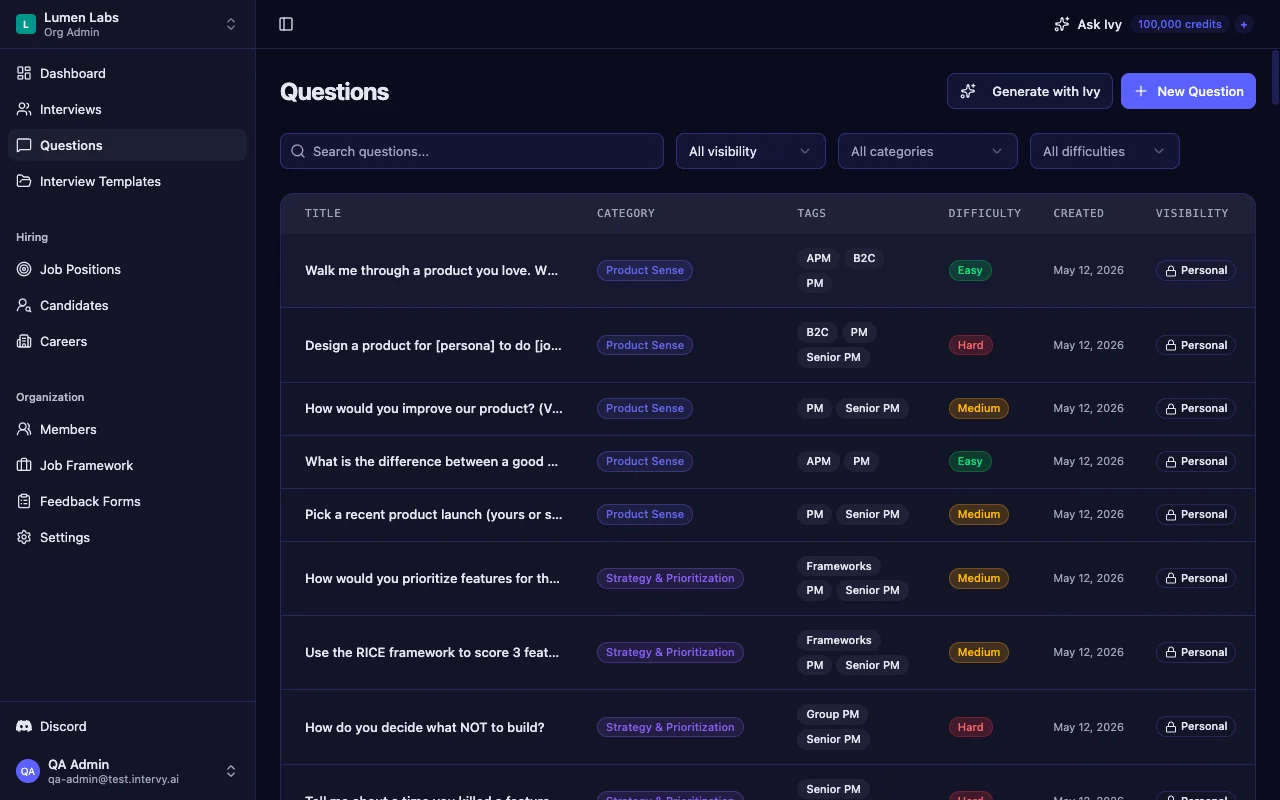
Q1 — Walk me through a product you love. (easy) Listen for a clear user and job-to-be-done, the mechanism that delivers value (not a feature tour), and the trade-offs the team made. A candidate who narrates the feature list reasons from features outward, not from users inward.
Q2 — Design a product for [persona] to do [job]. (hard) The right answer never starts with features. It starts with clarifying questions, grounds in a persona and goal, prioritises a small feature list with reasoning, and names a success metric. Jumping to features is the most common red flag in the PM loop.
Q3 — How would you improve our product? (medium) is your highest-leverage product sense question. A great answer follows a visible structure: goals → current state → gaps → proposals → pick ONE → success metric. A laundry list with no prioritisation tells you the candidate will run your roadmap the same way.
Key takeaway: Product sense isn't about how clever the idea is. It's whether the candidate can show their work — user, goal, mechanism, trade-off, metric — under time pressure.
Strategy and Prioritisation
Strategy questions separate APMs who run frameworks by rote from Senior PMs who pick the right framework and name its weaknesses.
Q7 — Use the RICE framework to score 3 features I'll describe. (medium) A worked example to calibrate your panel:
| Feature | Reach | Impact | Confidence | Effort | RICE |
|---|---|---|---|---|---|
| Bulk export to CSV | 4,000 | 1 | 80% | 1 | 3,200 |
| AI-suggested categories | 12,000 | 2 | 50% | 4 | 3,000 |
| Single-sign-on for SMB | 800 | 3 | 90% | 3 | 720 |
A Strong Yes candidate scores all three with sane numbers, then calls out that Confidence is the most gameable input and SSO might still win on strategic fit. A Maybe candidate computes the formula and stops.
Q8 — How do you decide what NOT to build? (hard) Listen for opportunity cost, strategic fit, maintenance burden, and the ability to say no in plain words. A candidate who has never said no will struggle on a Senior PM ladder.
- Sunk-cost discipline. Q9 — Tell me about a time you killed a feature. Look for kill criteria written down before launch, not retroactively.
- Stakeholder communication. How did they sequence the conversation with eng, design, and the sponsor?
- Learning extracted. What did they take from the kill into the next bet?
Tip: When a candidate gives the textbook RICE answer, follow up with "When does RICE break?" — the honest answer is a Senior PM signal.
Execution and Delivery
Execution questions test whether a PM can keep a launch on the rails without bullying engineering or rubber-stamping every estimate.
Q14 — How do you scope an MVP under a hard deadline? (medium) The MoSCoW lens, applied honestly:
| Bucket | What it means | The honest test |
|---|---|---|
| Must have | Cut it, the release is meaningless | "Would I delay launch a week for this?" Yes. |
| Should have | Cut it, the launch lands weaker | "Would I delay a week?" No, but fast-follow. |
| Could have | Nice to have if everything's early | "Would anyone notice if it shipped 30 days later?" No. |
| Won't have | Out of scope, explicitly | The team can stop debating it. |
The Strong Yes candidate cuts ruthlessly, defines the learning goal of the MVP, and tells you what would make them re-prioritise mid-flight.
Q15 — A launch is one week away and QA finds a P0 bug. (hard) No single correct answer, but a correct shape: size the blast radius, lay out three options (fix and hold / delay one week / ship with a known issue plus a fast-follow), loop stakeholders, document the decision. Making the call alone in a panic is a red flag.
Q12 — How do you write a PRD? (easy) is one of the cheapest tells in the loop. A great PRD has:
- Problem framing. One paragraph on the user and the job.
- Success metric. The single number that decides whether this launched well.
- Scope, in and out. What's not in this release is more useful than what is.
- Open questions. Honest about what you don't know.
Key takeaway: Execution questions reveal whether a PM treats engineering as partners or as a vending machine. Listen for "we decided together", not "I told them what to build".
Metrics and Analytics
Metrics is where rehearsed framework answers collapse. Give candidates a real debugging scenario instead.
Q18 — What metric would you optimise for this product? Why? (medium) A Strong Yes ties the metric to product stage (activation early, retention mid-stage, revenue mature) and business goal. It names a primary plus 2-3 supporting metrics, plus a counter-metric — the thing you'd track to make sure the primary isn't being gamed.
Q19 — Our DAUs dropped 20% this morning. Walk me through your debugging process. (hard) Listen for a structured debugging tree, not a single hypothesis:
- Internal vs external. Did we ship anything in the last 24 hours? Regional outage or competitor launch?
- Tracking pipeline first. Is the dashboard correct, or did the event-tracking job fail?
- Segment systematically. Platform, cohort, geography, feature surface.
- Hypotheses ranked by likelihood. Most outages are dumb — a deploy, a config flip, a tracking break.
A candidate who jumps straight to a fix would hot-patch your production data the same way.
Q23 — An A/B test shows +0.5% on the primary metric, p=0.06. Do you ship? (hard) The question that most cleanly separates frameworks from judgment. The wrong answer is dogmatic. The right answer asks: cost of being wrong, prior, guardrail metrics, can we extend?
Tip: For mid-level candidates, ask them to define leading vs lagging indicators. For senior candidates, give them a metric and ask which it is — the direction tells you whether they reason about cause and effect.
User Research and Stakeholder Management
Two rounds that look soft and are anything but. They test whether a candidate holds a position under pressure and still leaves the room with the relationship intact.
Q24 — Walk me through your last user interview. (easy) The tell is whether the candidate gives specifics about a real interview in the last 30 days — what they asked, what surprised them, what they'll do about it. Pivoting to "our research team owns that" is the red flag.
Q28 — A stakeholder is pushing for a feature the data says won't move metrics. (hard) A political-competence test. Strong candidates surface the underlying goal, present data calmly, propose an alternative, and document the decision. Just says yes or just says no — both fail.
Q26 — A power user requests a feature 10 other customers haven't asked for. (medium) A great answer runs the rep / non-rep test, sizes addressable demand against build cost, looks for a workaround, and names the opportunity cost.
Key takeaway: Research and stakeholder rounds reward candidates who hold a clear position grounded in evidence, then stay generous with everyone in the room.
Behavioural and Leadership
Behavioural is the round most often mis-run. Panels treat it as a vibe check; in practice it's the most predictive round for whether the candidate will operate at the level you're hiring for.
Q36 — Tell me about a time you led without authority. (medium) The single best behavioural question for Senior PM and Group PM signal. Listen for context, influence levers (data, vision, trust, sequencing), outcome, and what they learned. "I just told them what to do" is a Strong No.
Q37 — What's the hardest call you've ever made as a PM? (hard) A level calibrator. A Senior PM hard call is roadmap re-prioritisation in flight; a Group PM hard call is killing a line of business. If the hardest call sounds easy at the level you're hiring, that's the signal.
Q35 — Tell me about a time you failed. (easy) A real answer names a real failure (not "I cared too much"), surfaces a root cause they own, and shows what changed.
Tip: Use STAR (Situation, Task, Action, Result) as a listening structure, not an answer structure. If the candidate hits all four without prompting, that's already a Yes signal.
How to Structure a PM Interview Loop
Knowing the questions is half the battle. The other half is sequencing them across a real loop.
45-minute hiring-manager screen
- Minutes 0-5. Calibration and role context.
- Minutes 5-15. Two product-sense openers (Q1, Q3).
- Minutes 15-30. One strategy, one execution (Q8, Q14).
- Minutes 30-40. One behavioural calibrator (Q40 — why this role).
- Minutes 40-45. Candidate questions.
5-round on-site
- Recruiter screen (30 min). Logistics, motivation, deal-breakers.
- Hiring manager (45 min). Q2, Q7, Q8.
- Product sense deep dive (60 min). Q2 variant + Q3 + Q18.
- Execution and metrics (60 min). Q14, Q15, Q19, Q23.
- Cross-functional bar raiser (45 min). Q26, Q28, Q36 from a peer in eng or design.
- Executive (30 min). Q40 plus candidate questions.
Intervy's pipeline editor supports this shape natively: phases at the same layer run in parallel, and the next layer waits until the current layer's interviews complete or skip.
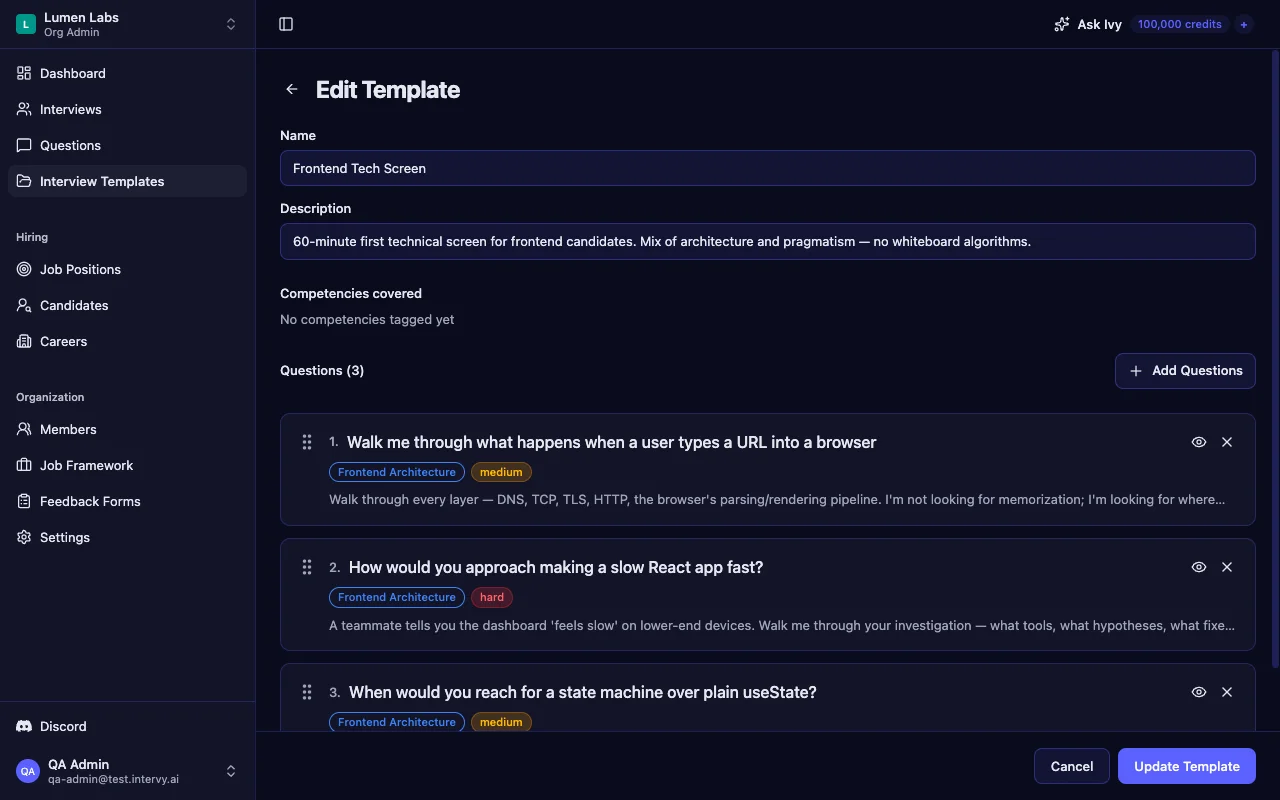
Build a reusable Senior Product Manager Interview template by selecting questions and reordering them with drag-and-drop. Lock the template to a phase so every interviewer in that round runs the same set.
Scoring PM Answers Consistently
Consistent scoring is what turns interview notes into a hiring decision. Intervy's interview scoring tool uses a 5-point default scale on the conduct view, swappable for a 1-4 or custom scale at the organization level (the chosen scale is snapshotted onto each interview at start).
- Strong No (1) — fundamentally wrong, or red-flag answer.
- No (2) — partial understanding, no trade-offs visible.
- Maybe (3) — factually correct, surface-level, no reasoning underneath.
- Yes (4) — solid answer with trade-offs and a real example.
- Strong Yes (5) — exceptional depth, names framework weaknesses unprompted.
| Question | Maybe (3) | Yes (4) | Strong Yes (5) |
|---|---|---|---|
| Q2 — Design a product | Picks a persona | Adds success metric | Names trade-offs and v2 |
| Q8 — What not to build | Names opportunity cost | Tells a real story | Quantifies the no |
| Q19 — DAUs dropped 20% | Lists three hypotheses | Structures the tree | Checks tracking first |
| Q36 — Lead without authority | Names a real situation | Shows the influence lever | Extracts leadership lesson |
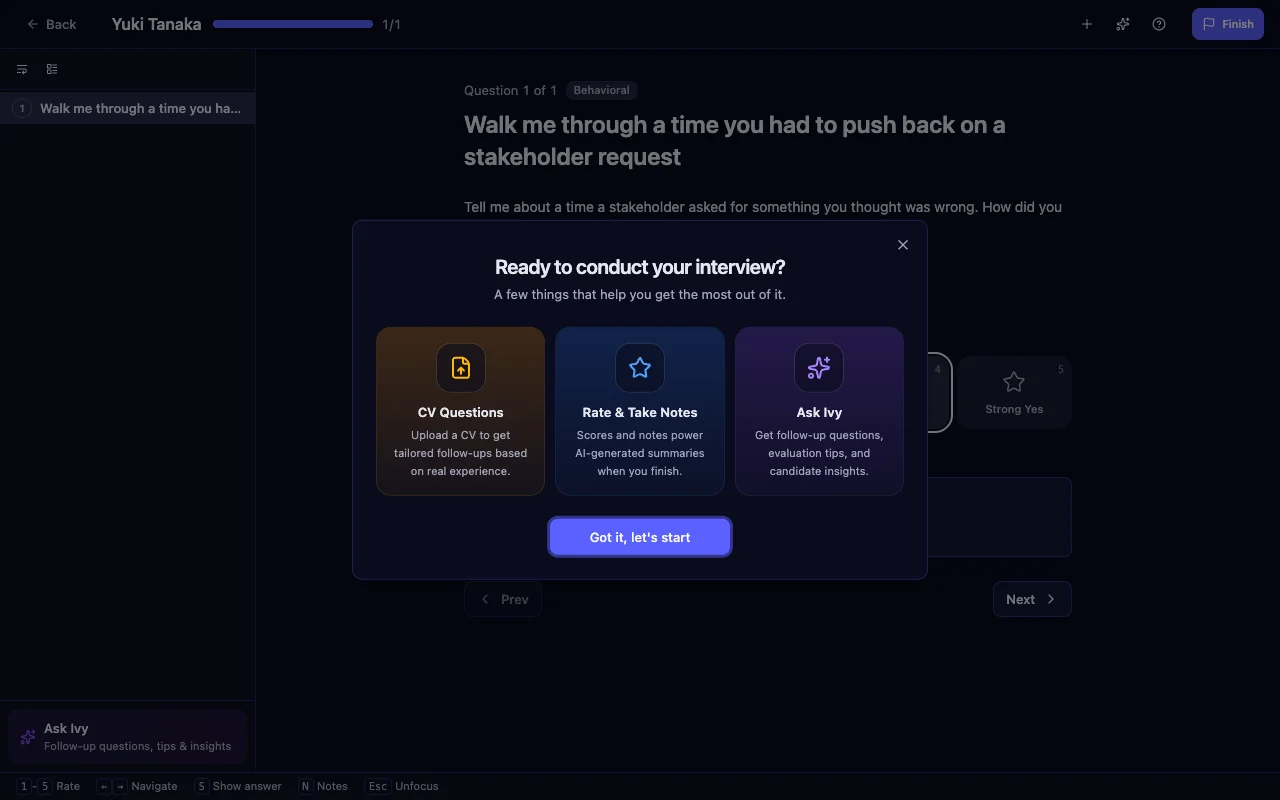
The conduct view captures each question's rating and comment as the interview happens. Intervy also supports per-phase feedback forms, so the product-sense round and the execution round don't share a single freeform summary box. Each phase defines structured fields — for example "Product Sense (rating)", "Strategy Trade-offs (rating)", "Red Flags (text)" — that every interviewer in that round fills out.
Key takeaway: The 5-point rubric is a human judgment surface, not an automated grade. Ivy, our AI interview question generator, drafts questions and follow-ups, but every score is your interviewer's call. Intervy also supports a per-role competency matrix mapping competencies against levels (APM through Director), so a Maybe at Senior PM doesn't get confused with a Strong Yes at APM.
Explore All 40 PM Interview Questions
This guide highlighted 14 questions. The full set of 40 product manager interview questions — across product sense, strategy, execution, metrics, research, stakeholders, design sense, and behavioural — with reference answers, difficulty ratings, and category tags is on our Product Manager interview questions page.
For adjacent non-engineering roles, see our Project Lead and Scrum Master banks. Our structured technical interviews guide walks through templates, calibration, and debriefs — most of the playbook applies one-to-one to PM hiring. The index at /interview-questions lists every question bank we ship.
Want to use these questions in your next interview? Grab all 40 at once — head to the Export / Import page in Intervy, select "Product Manager (40 questions)" from the Sample Interview Data dropdown, and click Load. Categories, difficulty chips, tags, and the Senior Product Manager Interview template come pre-wired.