25 Engineering Manager Interview Questions That Find Real Leaders
On this page
- One Bank, Three Job Titles
- What an EM Interview Should Actually Test
- People Management & Coaching
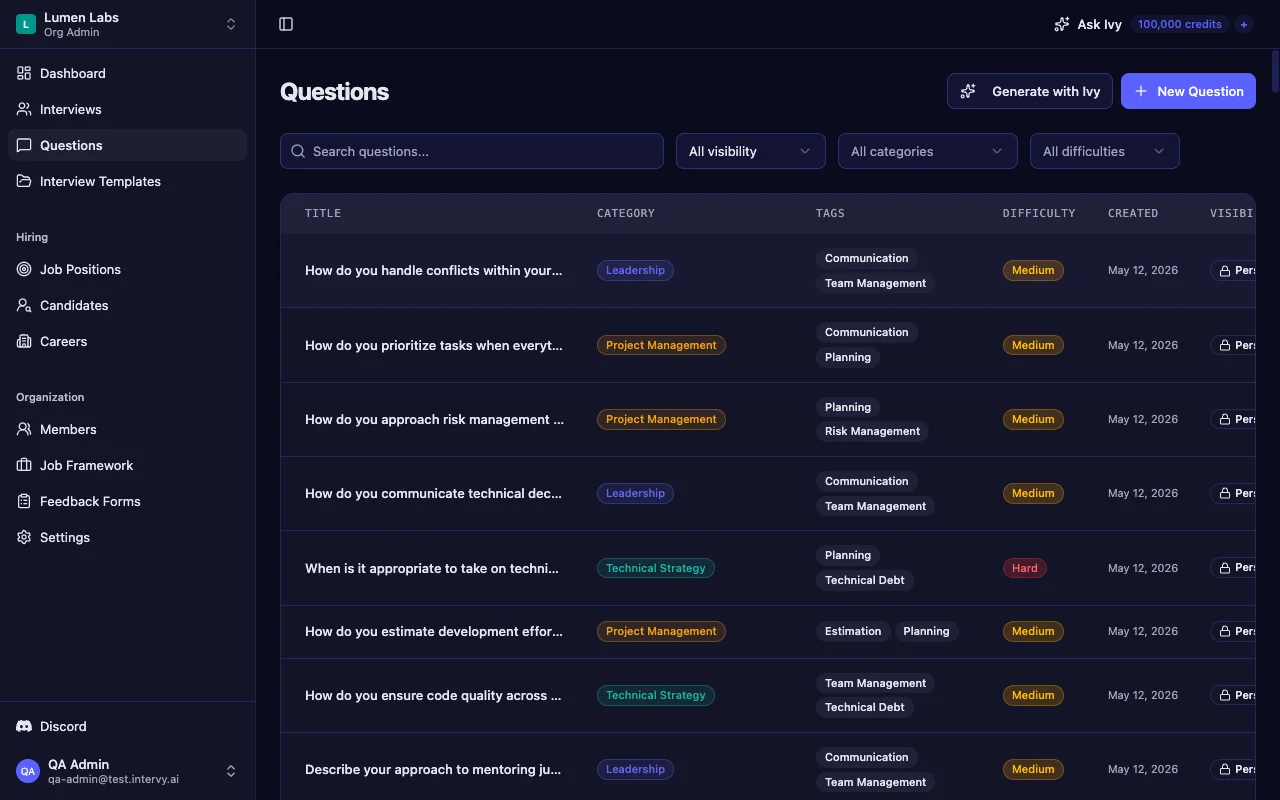
- How do you handle conflicts within your development team?
- Describe your approach to mentoring junior developers.
- How do you handle a high-performing team member who is also disruptive to team culture?
- How do you onboard a new developer onto an existing project quickly?
- Technical Leadership & Architecture Calls
- When is it appropriate to take on technical debt? How do you manage it?
- How do you ensure code quality across your team?
- How do you decide when to build in-house versus use a third-party solution?
- Project Planning & Execution
- How do you estimate development effort for a new feature?
- How do you approach risk management in a software project?
- How do you plan and execute a major release with multiple teams involved?
- How do you approach a team that is consistently missing sprint commitments?
- Prioritization & Roadmap Calls
- How do you prioritize tasks when everything seems urgent?
- How do you decide what NOT to build?
- Cross-Functional Stakeholder Work
- How do you communicate technical decisions to non-technical stakeholders?
- How do you manage a stakeholder who keeps changing requirements mid-sprint?
- How do you handle a stakeholder who bypasses you and goes directly to your developers?
- From Question Bank to Structured Interview
- The Per-Category Score Is the Whole Argument
- Get Started
Most "engineering manager interview questions" lists are a soup of behavioral clichés — "tell me about a time you failed," "what's your management style?" — with no rubric for what a good answer actually sounds like. That's not interviewing; that's vibes-based hiring. This guide gives you 25 engineering manager interview questions drawn from a real bank, each with a rubric of what to listen for and the red flags that should kill the offer.
TL;DR: 25 engineering manager interview questions across people management, technical strategy, planning, prioritization, and stakeholder work — each with a "listen for" rubric. The same bank works for EM, tech lead, and project lead hiring because the underlying competencies are identical.
One Bank, Three Job Titles
A quick honesty note. The Intervy bank these come from ships under the slug project-lead, not "engineering manager" — intentional, not a typo. An engineering manager, a tech lead, and a project lead are hired against the same six competencies (delivery, stakeholder management, technical strategy, people leadership, prioritization, planning). Titles differ across companies; the interview signal is identical. Canonical landing page: /interview-questions/project-lead.
Tip: Hiring a first-time EM (promoting an IC)? Use this bank as your full interview. Hiring an experienced EM? Use it as the leadership track and pair it with a separate IC technical screen — this bank intentionally skips system-design and coding.
What an EM Interview Should Actually Test
The seed defines six color-coded categories, and those six are the argument for what an EM interview should cover — the dual mandate of the job is ship product, grow people.
- Leadership — people management, coaching, conflict, team culture.
- Project Management — estimation, risk, planning, execution.
- Technical Strategy — architecture decisions, tech debt, build-vs-buy.
- Stakeholder Management — non-technical communication, scope changes, escalations.
- Prioritization — what to build, what to kill, how to say no.
- Delivery — releases, sprint health, cross-team coordination.
Notice what's not there: system design, algorithms, coding under pressure. That's deliberate. This is a leadership bank — if you need an IC technical screen, run one separately.
Key takeaway: An EM interview should test judgment across leadership, technical strategy, and delivery — not the technical depth the IC interview already covered.
People Management & Coaching
This is where EM hires live or die. A new EM who can't run a 1:1 or handle a performance issue burns the team within a quarter — and that damage is much harder to undo than a shipped bug.
How do you handle conflicts within your development team?
The strongest single question for separating facilitators from escalators. The seed's rubric flags private conversations first and focusing on interests, not positions as the signal.
- Listen for: acknowledging conflict is normal, gathering context before judging, mediating without picking sides.
- Red flag: "I escalate to my manager" as a first move. That's not resolution; that's avoidance.
Describe your approach to mentoring junior developers.
The growth half of an EM's job. Probe for systematic mentoring — 1:1s, growth plans, pairing rotations — not ad-hoc Slack help.
- Listen for: growth plans tied to career level, deliberate stretch assignments, feedback loops.
- Red flag: mentoring described purely as "answering questions when they ask."
How do you handle a high-performing team member who is also disruptive to team culture?
The highest-signal EM question on the list. Candidates who tolerate cultural damage because "they ship" are not ready to manage.
- Listen for: explicit acknowledgment that performance and culture are both required, direct conversation about specific behaviors, willingness to manage the person out if patterns don't change.
- Red flag: any version of "you can't lose your top performer." Wrong frame entirely.
How do you onboard a new developer onto an existing project quickly?
Hiring velocity is meaningless if onboarding is broken. This reveals whether the candidate has thought about onboarding as a system, not as an HR task.
Tip: Score Leadership questions on the same scale as everything else, but weight them when you compare candidates. Two strong-yes answers here predict EM success better than two strong-yes answers anywhere else.
Technical Leadership & Architecture Calls
EMs don't write production code, but they own technical direction. These questions probe judgment, not implementation.
When is it appropriate to take on technical debt? How do you manage it?
Reveals whether the candidate sees tech debt as engineering hygiene or as a business lever (incur it deliberately for speed, then pay it down). Senior EMs do the second.
- Listen for: intentional vs. accidental debt distinction, paydown windows in the backlog, the trade against velocity made consciously.
- Red flag: "we don't take on tech debt." Either they're lying or they've never shipped at startup pace.
How do you ensure code quality across your team?
Strong EMs answer with a mix — CI gates and linting (automation) plus code review and post-mortems (culture). Weak EMs lean entirely on one or the other.
- Listen for: both layers, with examples of how they reinforce each other.
- Red flag: "100% test coverage" or "everything goes through code review" as a standalone answer.
How do you decide when to build in-house versus use a third-party solution?
A stand-in for "do you understand opportunity cost?" The rubric values total-cost-of-ownership thinking: licensing + integration + maintenance + opportunity cost of the team's time.
Key takeaway: Technical Strategy questions probe judgment under uncertainty. The reasoning is the signal, not the conclusion.
Project Planning & Execution
EMs lose stakeholder trust fastest through bad estimation and missed releases. These questions test whether the candidate has lived through that pain.
How do you estimate development effort for a new feature?
The most diagnostic Project Management question. Senior candidates think in ranges and reference historical data; junior candidates give point estimates and add a 20% buffer.
- Listen for: breakdown into tasks, ranges instead of points, historical velocity, explicit uncertainty buffer.
- Red flag: "I ask the engineer and add 50%." That's offloading the EM's job onto the IC.
How do you approach risk management in a software project?
A four-stage rubric: identification → assessment → mitigation → monitoring. Candidates who skip any stage have only managed projects that didn't go sideways yet.
How do you plan and execute a major release with multiple teams involved?
Reveals whether the candidate understands rollouts, war rooms, feature flags, and rollback plans — or whether they merge to main and hope.
- Listen for: staged rollout (canary → percentage → full), feature flag gating, a documented rollback procedure, comms plan during the release window.
- Red flag: "we deploy Friday afternoons and monitor over the weekend."
How do you approach a team that is consistently missing sprint commitments?
System-thinking question. Strong answers investigate process — over-commitment, interruption load, unclear scope, missing skills — before pointing fingers.
Tip: When the candidate answers an execution question, ask "what's an example?" The detail in the example reveals whether they've actually done this or just read about it.
Prioritization & Roadmap Calls
Most candidates can tell you what they'd build. The senior signal is what they'd kill — and how they'd defend that kill upward.
How do you prioritize tasks when everything seems urgent?
Ask which framework they actually use — RICE, MoSCoW, Eisenhower — and what its failure mode is. Candidates who name a framework but can't critique it have read about it, not used it.
- Listen for: specific framework with a reason, awareness of where it breaks down, examples of real trade-offs under pressure.
- Red flag: "I prioritize based on business value." Without specifics, that means nothing.
How do you decide what NOT to build?
The most senior-signaling question in this section. Probes whether they can say no — and specifically whether they can say no upward.
- Listen for: explicit framework for killing work, example of saying no to a senior leader and surviving.
- Red flag: "I push back on PMs but do what leadership wants." That's a courier, not a leader.
Cross-Functional Stakeholder Work
EMs spend more of their week talking to non-engineers than they expected. These questions test whether they're good at it.
How do you communicate technical decisions to non-technical stakeholders?
The seed's rubric is explicit: start with the business problem, not the technical solution. That's exactly the failure mode of newly-promoted EMs who lead with the architecture diagram.
How do you manage a stakeholder who keeps changing requirements mid-sprint?
Probes whether the candidate fights change or absorbs it through process. Both extremes fail: EMs who refuse all change burn relationships, EMs who absorb all change burn their team.
- Listen for: scope-change process (impact analysis, swap-not-add discipline), explicit cost conversation, distinction between emergencies and ongoing scope creep.
- Red flag: "I just push back on PMs." Adversarial framing fails this question.
How do you handle a stakeholder who bypasses you and goes directly to your developers?
Tests ego and curiosity in equal measure. The strong answer investigates why the bypass happened before installing a process fix.
Key takeaway: Stakeholder questions are where you'll find the biggest variance between candidates who look great on paper and candidates who actually run teams well. Weight these.
From Question Bank to Structured Interview
Knowing the right questions is the easy half. The hard half is using them consistently — same questions for every candidate, scored in the moment, with per-category data you can compare.
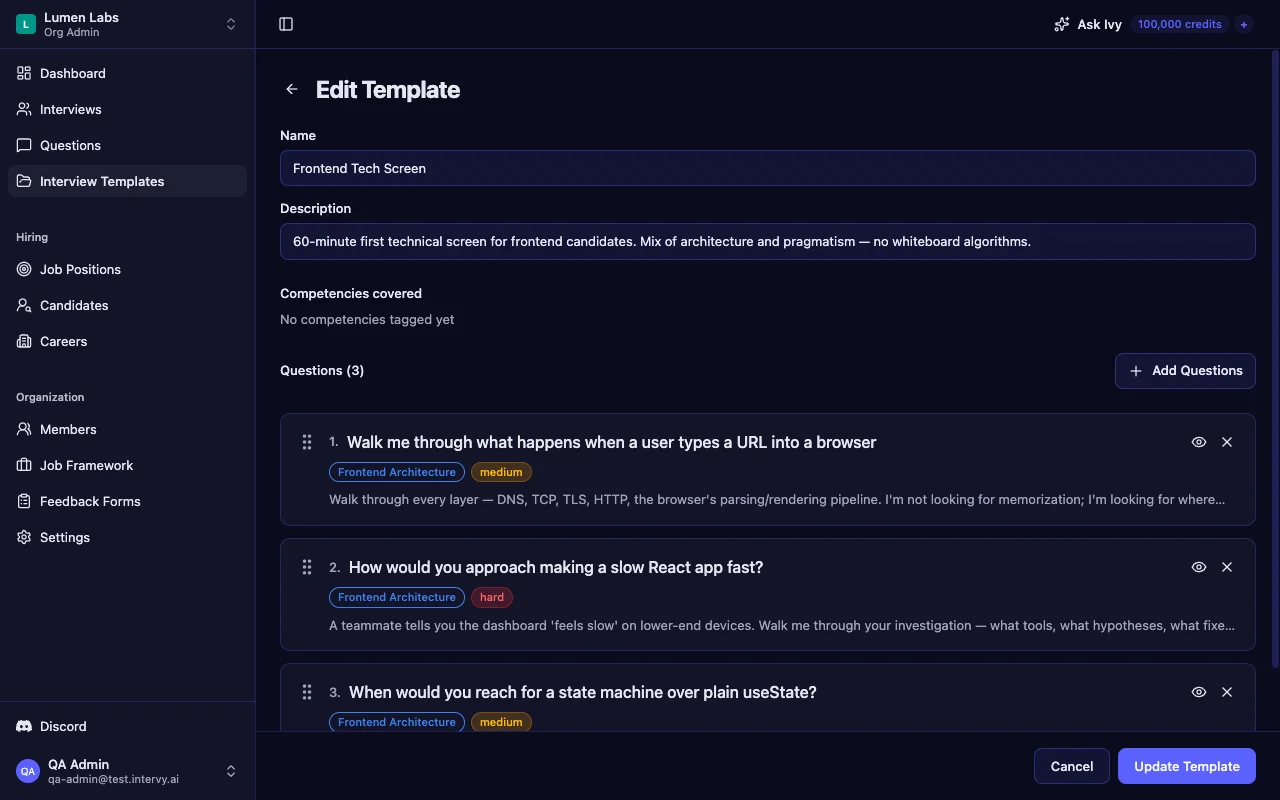
Intervy is built as a structured interview tool for exactly this workflow. Importing the project-lead seed installs both the question bank (with all rubrics) and a ready-to-run interview template of 10 hand-picked questions. The interview template builder lets you customize per role — duplicate, swap in tougher questions for a senior EM, simpler ones for a first-time EM.
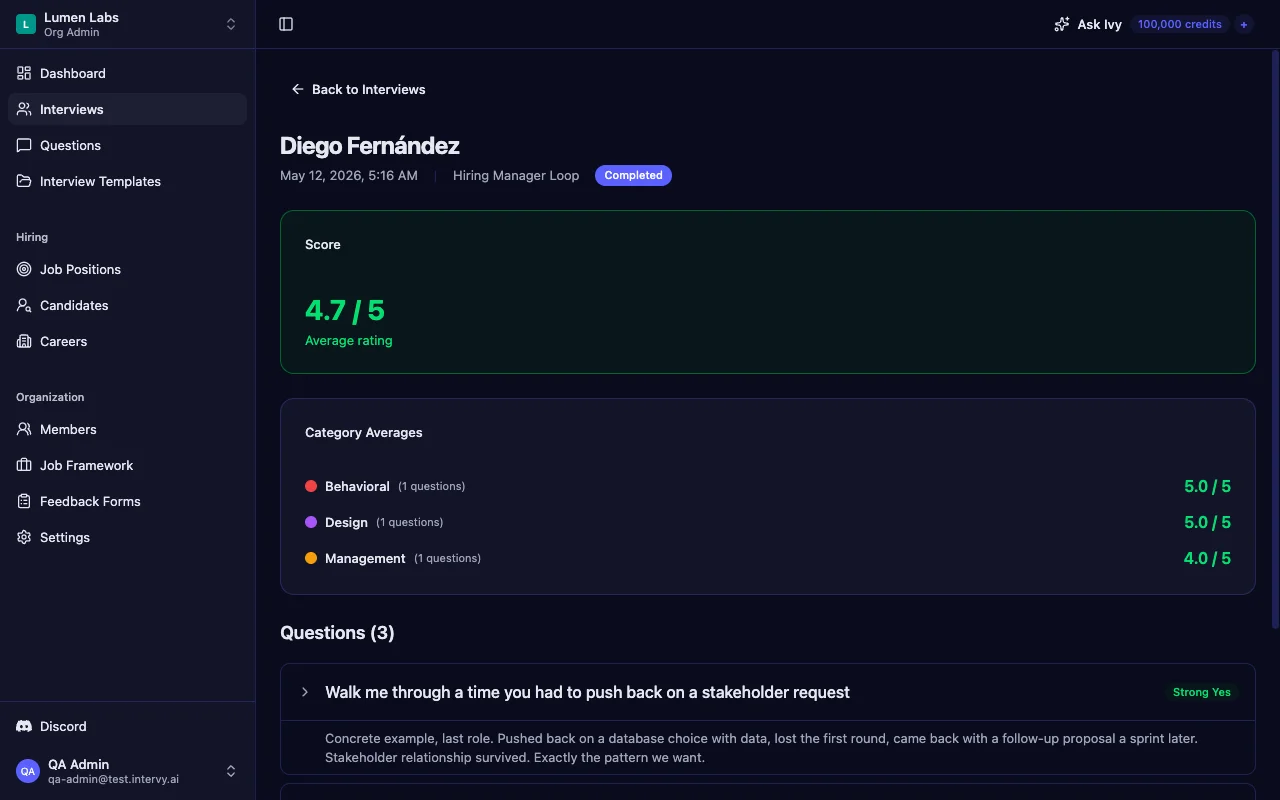
During the interview, you score each answer live on a configurable scale — the default is 5 levels (Strong No / No / Maybe / Yes / Strong Yes), with 3-level and 10-level presets available.
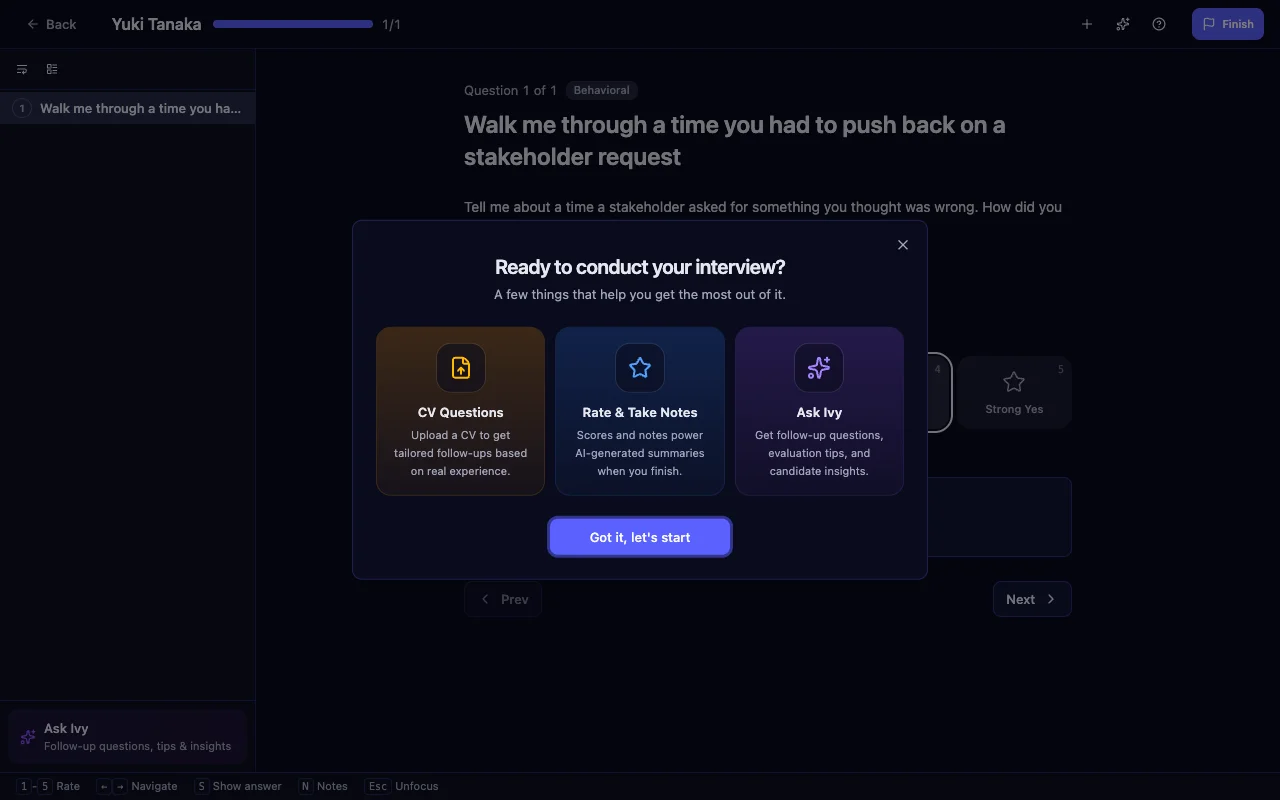
When the candidate's CV mentions specific claims, the AI panel can draft targeted follow-up questions during the interview itself. They appear inline, flagged with their source, and score on the same scale as the template questions. If you're running a multi-round loop, the platform also enforces phase ordering at the data layer — a technical screen at phase 1 must complete before the behavioral round at phase 2 starts.
The Per-Category Score Is the Whole Argument
An EM candidate finishes the loop with a 4.2/5 average. Looks great. Until the review page breaks it down: Leadership 4.5, Technical Strategy 4.6, Delivery 4.7 — and Stakeholder Management 2.5.
That's a fail. And it's the exact kind of fail that an "overall vibe was good" debrief misses every time. The per-category breakdown — built on top of the same six seed categories you used to structure the questions — is the single strongest reason to use an interview scoring tool instead of a Google Doc.
Tip: Run a calibration session before your first structured EM interview. Have two people independently score the same recorded mock answer. The gaps will surprise you — closing them takes 20 minutes; closing them after a bad hire takes 6 months.
Get Started
Structured engineering manager interview questions produce structured EM hires. Organize them by competency, back each one with a rubric, score them live on a consistent scale, and compare candidates on the per-category breakdown — not on who told the best war story. That's the whole workflow Intervy is built around as an interview preparation app for hiring managers.
The full bank lives at /interview-questions/project-lead (yes, that's the slug; same competencies, different label). If you'd rather grab it directly into your workspace, open the Import section in Intervy, select the Project Lead seed, and click Load — both the bank and the pre-built template land in seconds.
For the broader workflow, read our structured technical interviews guide — it walks through the 4-step process (bank → template → live scoring → review) that this post's question list plugs straight into. And if you're staffing the IC side of the loop, our React interview questions collection covers the technical screen that should sit before the EM round.