30 Customer Success Manager Interview Questions That Work
On this page
- Why Most CSM Interviews Miss the Hire
- Onboarding Questions
- Adoption Questions
- Renewal & Expansion Questions
- Churn & Difficult Conversations
- Cross-Functional Influence
- Metrics & Tools
- Behavioral & Empathy
- How to Run a Repeatable CSM Hiring Loop
- A Four-Phase CSM Loop
- Scoring CSM Answers on a 5-Point Scale
- Closing the Loop
Most CSM interviews fail the same way. Three people on the panel come away saying "they were really nice" — and four months in, the same hire is great at being liked and quietly missing every renewal forecast. The fix is not more rapport. It is a structured interview tool that pulls every conversation back to outcomes: did this candidate own onboarding, adoption, renewal, and expansion in a previous account, or did they just attend the meetings? This guide gives you 12 of the strongest customer success manager interview questions from our full set of 30, with what to listen for, plus a repeatable hiring loop you can run across every CSM candidate.
TL;DR: 12 highlighted customer success manager interview questions across onboarding, adoption, renewal, churn, cross-functional influence, metrics, and behavioral — with "what to listen for" answers and a 5-point scoring rubric. The full set of 30 questions with reference answers is on our customer success manager interview questions page.
Why Most CSM Interviews Miss the Hire
CSM panels skew toward likability because the day-to-day work is relationship-heavy. That bias hides the part of the job that actually pays for itself — defending a base, expanding accounts, and saying difficult things to customers without losing them. A great customer success manager interview separates the two.
The pattern we keep seeing: a candidate who can talk fluently about "partnership" and "trusted advisor" but cannot answer "when does a renewal conversation start?" or "how do you forecast a renewal?" without hand-waving. Those are the hires who get blindsided by churn in their third quarter.
Tip: Before the interview, write down the two or three CSM outcomes you actually need this hire to own in their first year — gross retention, expansion ARR, time-to-first-value. Then weight your questions against those outcomes, not against personality fit.
The thirty questions in this guide cover eight categories: Onboarding, Adoption, Renewal & Expansion, Churn & Difficult Conversations, Cross-Functional, Metrics & Tools, Behavioral & Empathy, and Communication. The twelve below are the ones we'd put in a single loop if forced to choose.
Onboarding Questions
The first 90 days of a customer relationship sets the ceiling on everything that follows. These questions test whether a candidate runs onboarding as a structured project — or as a series of friendly emails.
Walk me through how you structure a customer's first 30 days.
You want to hear a kickoff agenda, success criteria captured in writing, a named executive sponsor on the customer side, one measurable outcome by day 30, and a recurring cadence. Strong candidates volunteer the artifact they leave behind — a one-page success plan, a shared tracker, a written kickoff summary sent within 24 hours.
Red flag: "we send them the help docs and book a check-in." That answer is shorthand for "I do not own the first 30 days."
A customer signed but their internal champion left the company two weeks in. What do you do?
This is the question that separates relationship-driven CSMs from outcome-driven ones. The strong answer pauses the rollout, re-maps stakeholders, re-discovers the business case with the new owner, and re-baselines success metrics in writing — even if the new owner says "just keep going."
- Strong answer. Stops the clock, owns a re-discovery conversation, gets the new sponsor to write down the goals they actually care about.
- Average answer. Schedules a coffee with the new owner, sends a recap, presses on with the original plan.
- Red flag. Treats the champion's departure as a calendar problem rather than a deal-risk event.
Key takeaway: Onboarding questions test ownership, not friendliness. The best CSM hires write things down, name a sponsor, and treat the first 30 days like a project plan.
Adoption Questions
Adoption is where most "nice-but-not-strategic" CSMs get exposed. Logins are not value. These questions check whether the candidate connects product behavior to the customer's business outcomes.
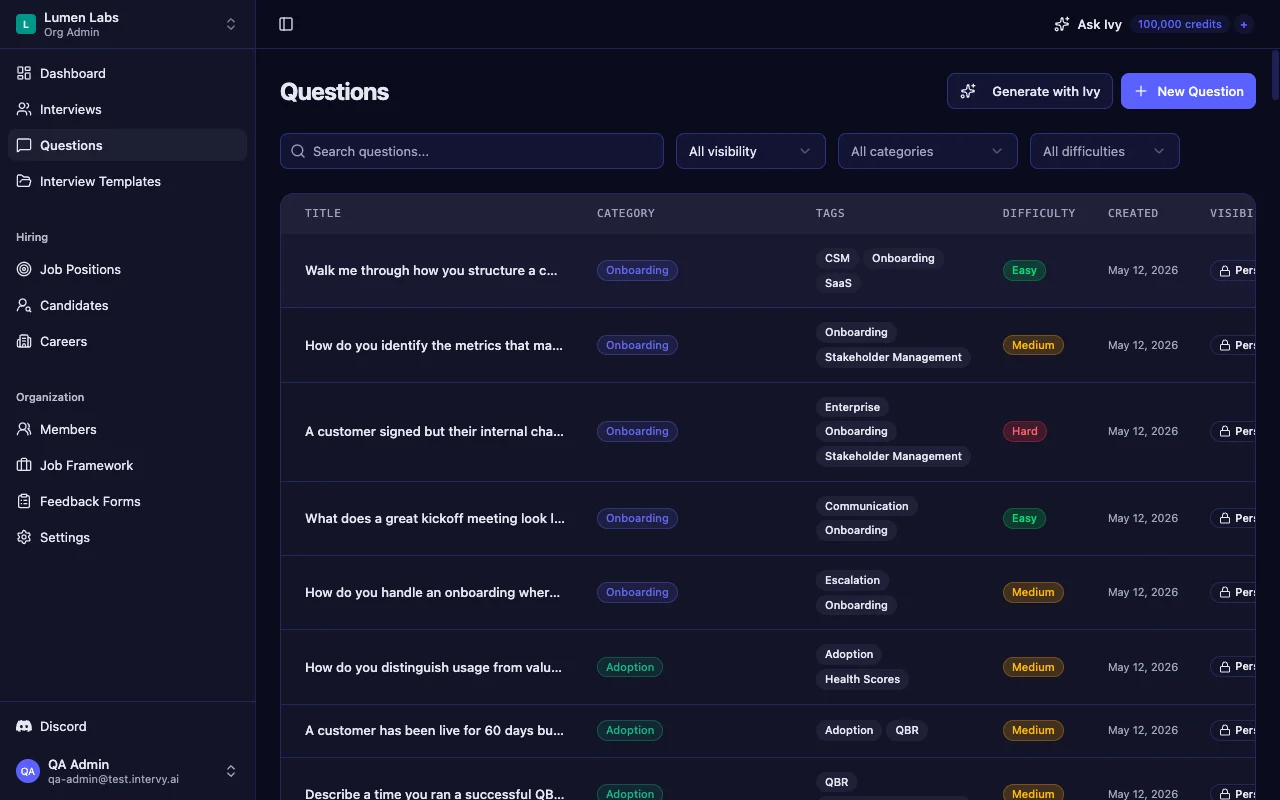
How do you distinguish usage from value?
The answer you want: usage is what shows up in the dashboard; value is what the customer can defend to their CFO. A great CSM ties product behavior to a specific business KPI the customer already cares about — pipeline created, tickets resolved, time saved, revenue retained.
Listen for a concrete example of a high-usage / low-value account they have managed in the past. That story is the proof.
How do you build and maintain a customer health score?
You are looking for five elements: inputs (usage signal, sentiment, support tickets, exec engagement, renewal recency), weightings that make sense, action thresholds (what happens at red? amber?), regular recalibration, and a clear answer to "who acts when the score moves?". Candidates who describe a health score as "a dashboard we look at in QBRs" do not own retention — they observe it.
Tip: Pair adoption questions with one product-knowledge probe — "what's the most counterintuitive thing your previous product does well?" — to confirm the candidate actually used the tool, not just talked about it.
Renewal & Expansion Questions
This is where the commercial instinct of the candidate either shows up or does not. A great CSM treats renewal as the consequence of value already delivered. A weak CSM treats it as a calendar event that happens 60 days out.
When does a renewal conversation actually start?
The answer is "on day one." Anything else is a yellow flag. Strong candidates explain how they track value moments across the term and surface them in QBRs — so renewal becomes a recap rather than a negotiation.
A customer says they want to "pause" their contract. What's your next move?
A pause is almost never a pause. It is a churn signal wrapped in polite language — usually budget, internal change, or a fit problem the customer is not ready to name. The strong answer surfaces the real reason before responding to the framing, and presents the cost of pausing (lost momentum, reonboarding, expansion delay) against renegotiated scope.
- Strong answer. Refuses to accept the surface framing, asks discovery questions about what changed internally, brings options to the next call.
- Average answer. Escalates to manager, asks legal about pause clauses.
- Red flag. Offers a discount in the first email.
Key takeaway: A great CSM with commercial instinct does not flinch on the renewal questions. If the candidate keeps redirecting to "relationship," they are an account manager — which is a different hire.
Churn & Difficult Conversations
Composure under bad news is the single most underrated CSM trait. These questions surface it without needing a role-play.
A customer just gave a 30-day cancellation notice. Talk me through your first 48 hours.
The strong answer is calm and procedural: stop-the-bleed call within 24 hours with the right exec in the room, get the real reason for cancellation in writing, exec-to-exec escalation if relevant, present concrete options (scope change, paused services, alternative pricing) — not a panic discount.
Watch for two failure modes: jumping straight to a discount ("we can do 20% off"), or going silent ("I would loop in my manager"). Both telegraph that the candidate has not lost an account before.
Describe a customer relationship that went sideways. What would you do differently?
This is the STAR question that catches the candidate who never owns failure. You want a specific situation, a named tension (not "communication"), a concrete intervention that did not fully work, and a habit they have changed because of it. The candidate who blames the customer is telling you exactly what they will do to your customers.
Cross-Functional Influence
CSMs spend half their time getting work done by people they do not manage. Product gaps, support escalations, sales handoffs. These questions probe how they get there without burning bridges.
A product gap is blocking three of your accounts. How do you get it prioritized?
The strong answer is structured, not loud. Quantified ARR impact across the three accounts. A written one-pager — reproducible context, customer quotes attached to revenue, not vice versa. Allies inside product, not end-runs around the product manager. A repeatable channel (a monthly CS-product sync, a shared backlog) rather than a Slack DM to the CTO.
Tip: Follow up with "what would you do if the PM still said no?" The honest answer is "accept it, communicate back to the customers, and look for a workaround" — not "escalate harder." Candidates who only have one volume setting tend to break cross-functional trust within a quarter.
Metrics & Tools
This is the only "technical" section in a CSM loop. Frame it as business literacy, not trivia. The candidate does not need to derive NRR from scratch — they need to know what they would actually do with the number.
Explain NRR vs GRR. Which one would you optimize for and why?
GRR is base retention, expansion stripped out. NRR adds expansion on top. The "which one" answer should depend on stage — early product-market fit cares about GRR (are we keeping what we sold?), later-stage scaling cares about NRR (is our base compounding?). A candidate who confuses the two should not be running a senior account.
A customer's CSAT just dropped from 9 to 6. What do you do first?
You want: do not panic, get on a call within 48 hours, figure out whether this is a moment (one bad ticket) or a trend (something structural is breaking), pick one concrete recovery action, and time the follow-up survey appropriately so you are not begging for a number. Candidates who immediately reach for a Loom video or a discount are reacting to the score, not the customer.
Key takeaway: Metric questions are pass/fail on confusion. Either the candidate moves comfortably between NRR, GRR, CSAT, NPS, and health scores — or they do not. Senior CSMs do.
Behavioral & Empathy
The hardest section to score consistently, which is exactly why a structured rubric matters. Two questions we always include at the end of the loop:
- Describe a time you turned a detractor into an advocate. Look for a specific account, a specific intervention, and a measurable outcome — renewal, expansion, case study, or referral. Vague "we built trust" answers are not answers.
- What is the part of customer success that you find genuinely hard? This is a self-awareness check. The polished "honestly, nothing — I love every part of it" is a red flag. You want a thoughtful, slightly uncomfortable answer.
The remaining eighteen questions — covering kickoff dynamics, expansion qualification, QBR mechanics, support partnering, NPS pitfalls, and more — live on our customer success manager interview questions page.
How to Run a Repeatable CSM Hiring Loop
Knowing the right questions is half the work. The other half is running the same loop across every candidate so you can compare them like-for-like. Most CSM hiring failures we see come from inconsistent loops, not bad questions.
A Four-Phase CSM Loop
A loop is built from job position phases, each running its own template and feedback form, with later layers gated on earlier ones — so a candidate cannot land in front of the VP CS before the hiring manager has scored them.
- Phase 1 — Recruiter screen (30 min). Motivation, comp range, account-size fit, one onboarding question to filter the obviously unfit.
- Phase 2 — Hiring manager case (60 min). Two onboarding questions, two adoption questions, one renewal scenario. This is where most candidates get cut.
- Phase 3 — Cross-functional panel (60 min). Product partner, support partner, AE partner. Three questions from Cross-Functional, one from Metrics. The job is checking how the candidate works across the org.
- Phase 4 — VP CS leadership round (45 min). Renewal forecasting, expansion thinking, behavioral. One churn question. Final scorecard pass.
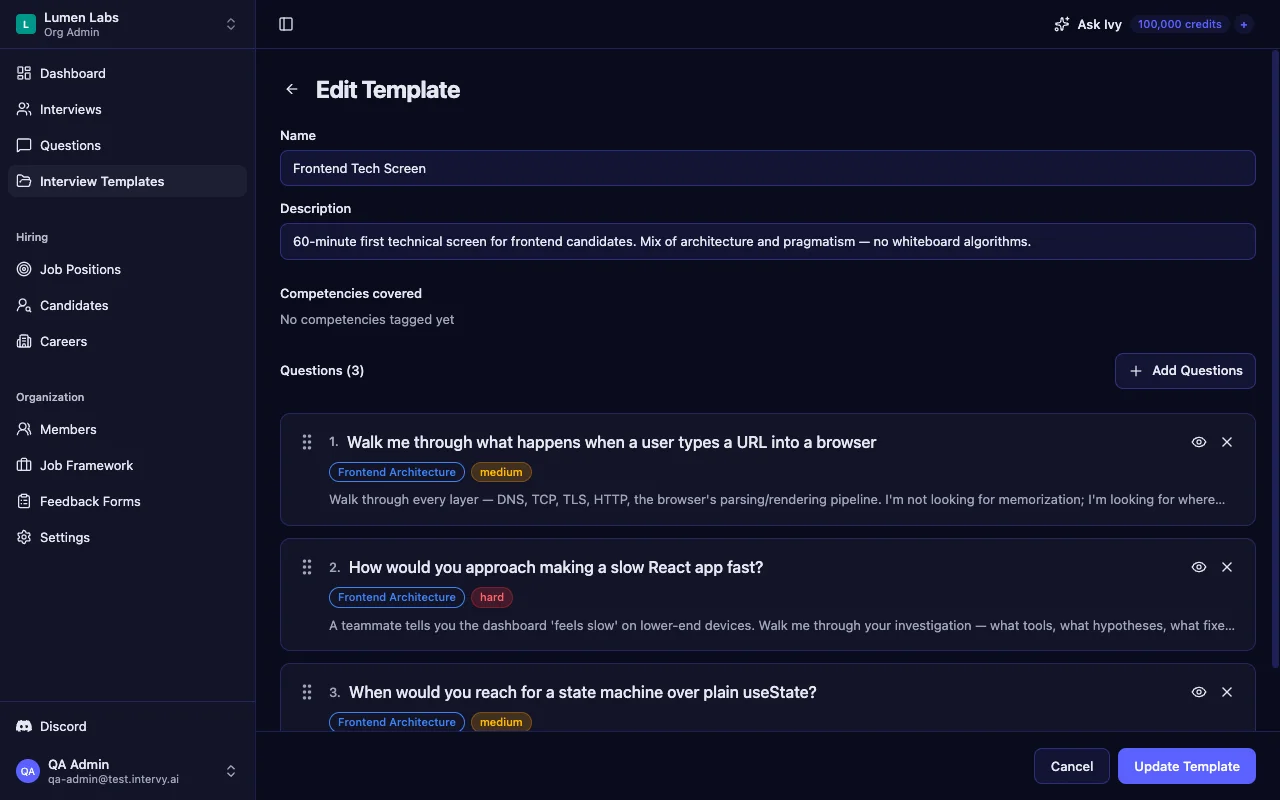
Templates built once and reused across every candidate are how you make this consistent. An interview template builder lets the hiring manager pin the same ten or twelve questions for every Phase 2 round — every candidate is graded on the same prompts, the comparison is real, and new interviewers on the panel inherit the calibration instead of inventing their own.
Scoring CSM Answers on a 5-Point Scale
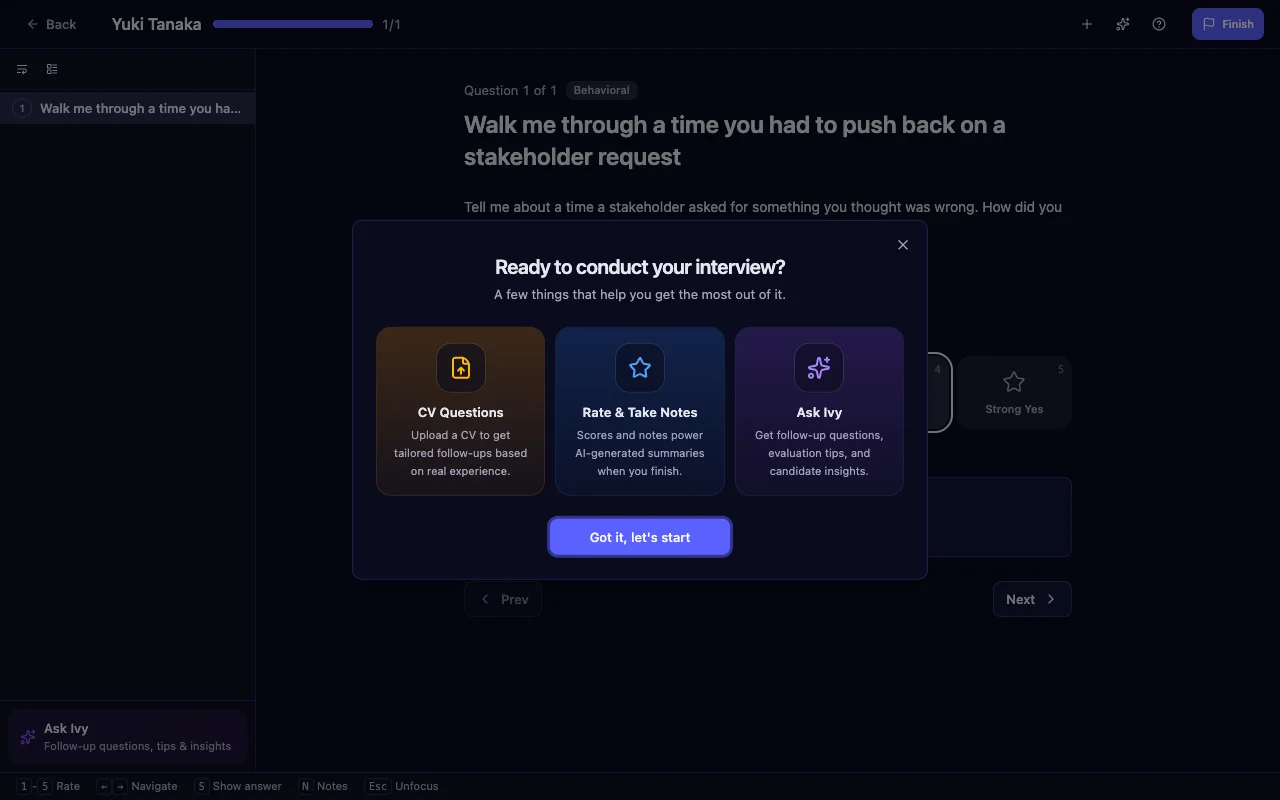
Consistency starts with the rating scale. Every answer gets rated 1–5 in the same interview scoring tool, with a comment, so the scorecard is not a single feeling — it is a row per question per interview.
- Strong No (1) — fundamentally wrong framing (e.g., "I would just discount it").
- No (2) — friendly but no ownership of the outcome.
- Maybe (3) — correct mechanics, surface-level reasoning.
- Yes (4) — solid answer with specific examples and trade-offs.
- Strong Yes (5) — exceptional — names a failure mode unprompted, brings a metric, has a habit they have changed because of it.
| Question | Maybe (3) | Yes (4) | Strong Yes (5) |
|---|---|---|---|
| Renewal start point | "60 days out" | "Throughout the term" | Names the value-moment artifact they track |
| Champion left | "Re-introduce ourselves" | "Re-baseline the success plan" | Pauses the rollout and re-discovers in writing |
| NRR vs GRR | Defines both correctly | Picks based on company stage | Connects to retention strategy in the role |
The rating row in Intervy is a fixed 1 Strong No → 2 No → 3 Maybe → 4 Yes → 5 Strong Yes scale by default, configurable per organization, with a comment box on every answer — so by the time the panel debriefs, every interviewer has the same five buttons and the same comparison shape.
Closing the Loop
A repeatable CSM hiring loop is three pieces, in order: a strong candidate screening tool at the top of the funnel, a consistent set of questions in every round, and a structured feedback form at the end so the scorecard is not retrofitted from memory two days later. Intervy is the second and third piece — the question bank, the templates, the rating scale, and the post-interview feedback form, all running off the same source of truth.
Want to use these questions in your next interview? You can grab all 30 of them at once — head over to our Import section and load them straight into your Intervy workspace in seconds.
For adjacent non-engineering roles, see our project lead interview questions page or our scrum master interview questions page. If you want to formalize the loop end-to-end, our guide to structured technical interviews walks through phases, scorecards, and panel calibration. And if you are working on a more consistent scoring rubric, our post on scoring candidates fairly is a good next read.
The full set of 30 customer success manager interview questions — with category, difficulty, tags, and "what to listen for" answers — lives on our customer success manager interview questions page, alongside the other role guides in our interview questions library.