35 Sales Interview Questions for AEs, BDRs & Closers
On this page
- Discovery and Qualification Questions
- Outbound and Pipeline Generation for BDRs
- Objection Handling and Negotiation Questions
- Closing and Forecasting Questions
- Behavioral and Coachability Questions
- Reference Calls and Take-Home Exercises
- How to Run a Repeatable Sales Interview Loop
- The 5-Point Scoring Rubric
- Building Templates by Role
- Extending the Bank with AI
- Start Running a Structured Sales Interview Loop
Most "sales interview questions" guides online are recycled icebreakers that tell you nothing about whether a rep can carry a quota. You need a structured loop — questions calibrated to seniority, a rubric your panel agrees on, and follow-ups that pressure-test pattern-matched answers. This guide gives you 15 highlighted sales interview questions drawn from a loadable bank of 35 — across discovery, outbound, objection handling, closing, and behavioral — with scoring guidance built in.
TL;DR: 15 highlighted sales interview questions out of a set of 35 — discovery, outbound, objection handling, closing, behavioral, and CRM hygiene. The complete bank is on our Sales Account Executive interview questions page.
Discovery and Qualification Questions
Discovery is where AE hires are made or lost. A candidate who pitches before they probe burns pipeline at scale, no matter how charming. These questions surface whether they run a framework — MEDDICC, SPICED, BANT, Sandler — or just wing it.
Walk me through the last deal you closed. What did you learn about the buyer in the first call?
Strong answers surface pain, quantified impact, the economic buyer, and a compelling event — in that order. Look for MEDDICC discipline. The red flag is describing their pitch and demo flow rather than what they learned.
What is your discovery framework? Walk me through how you apply it.
Candidates should name a framework AND show how they use it under fire, not just recite letters. A senior AE knows when to skip steps — identifying the economic buyer late when the champion is strong.
How do you qualify a deal out — and how early?
The signature hard question for senior AEs. The best reps disqualify fast. You want "no economic buyer means no deal" or "no compelling event, it goes to the parking lot." The red flag is "I never disqualify, I always find a way." That's how forecasts die.
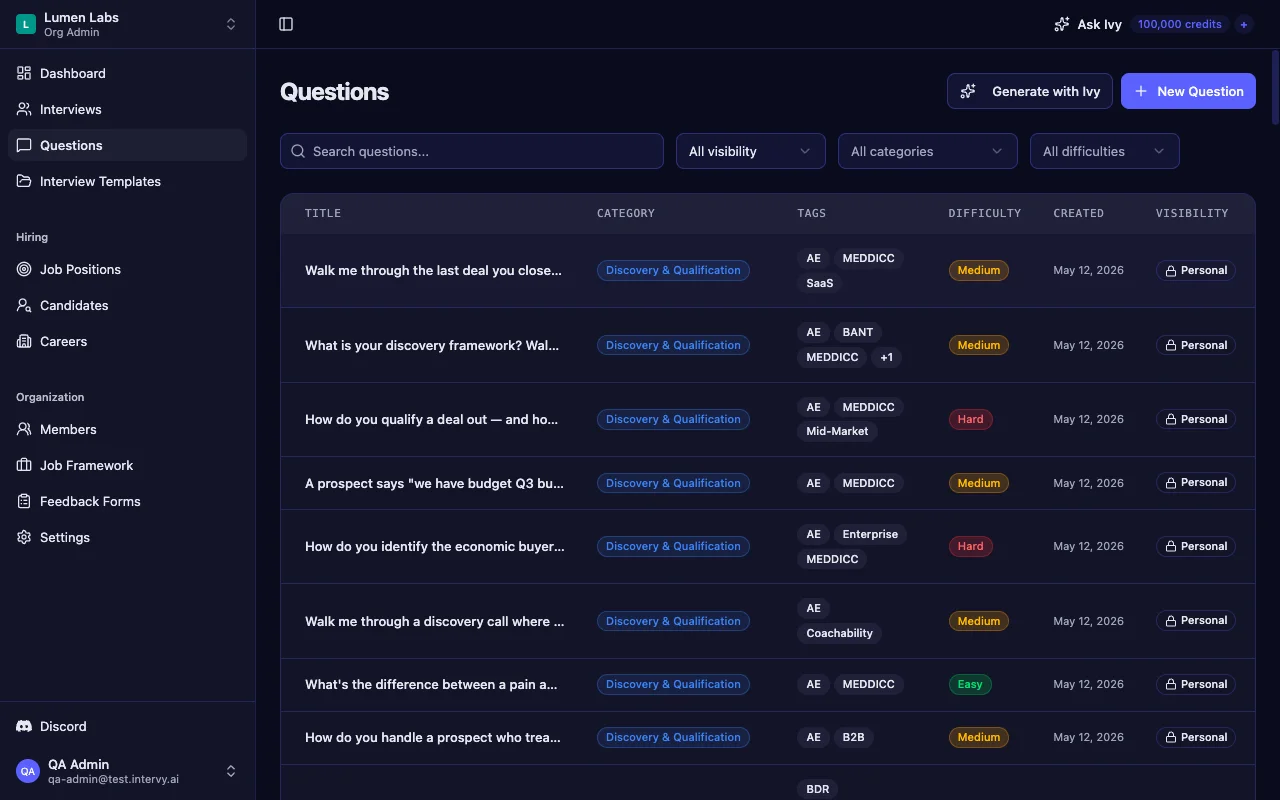
Tip: Follow up #1 and #2 with one specific deal name from their resume. Vague "I always do MEDDICC" answers collapse the moment you ask about a deal you can verify on LinkedIn.
Outbound and Pipeline Generation for BDRs
For BDR and SDR roles, you are buying activity discipline more than polish. These questions test how they think about list quality, cadence math, and what they do when a sequence underperforms.
Walk me through your daily outbound cadence. What does an effective prospecting day look like?
You want concrete numbers and time-blocking — 50 dials, 100 emails, 30 LinkedIn touches, mornings for calls, afternoons for research. Strong candidates triage replies daily and don't let inbox tasks displace dial blocks. A weaker candidate describes "a mix of activities" with no schedule.
Write me a cold email to a VP of Engineering at a 200-person SaaS company.
Run this live. Look for a short, specific, value-led subject line, one clear CTA, and zero "Hope this finds you well." The red flag is a six-paragraph email with three CTAs and a P.S. — that candidate has never measured a reply rate.
Your sequence has a 1.2% reply rate. The team average is 3%. What do you do?
A strong BDR diagnoses before blaming: audit list quality, A/B test subject lines, listen to a peer's calls, ask their manager for review. The red flag is "the list is bad" — a one-step answer that punts the problem to RevOps.
- Volume vs personalization. Strong candidates run a two-tier model — bulk top-of-funnel paired with hand-crafted tier-1 ICP outreach — and tie that split to deal-size math.
- The "send me more info" reply. Good BDRs never send unqualified collateral. They reply with one qualifying question or a 15-minute call ask.
- Research before reaching out. Five minutes of LinkedIn, recent funding, and hiring patterns is enough — anything longer is procrastination.
Objection Handling and Negotiation Questions
Objections separate AEs who sell on value from AEs who sell on price. You're listening for poise, curiosity, and the discipline not to discount first.
"Your price is too high." Walk me through your response.
The canonical objection. Pattern: acknowledge → probe ("compared to what?") → re-anchor on value → never discount first. Immediate capitulation ("we can probably do 20% off") is a hard no — that AE will train every buyer to push them on price.
"We already use [Competitor]." How do you keep the conversation alive?
Strong AEs validate the choice, find the gap their tool doesn't cover, and ask what the buyer wishes it did. Curiosity wins — candidates who bash competitors lose deals because buyers feel defensive about their previous purchase.
Procurement enters the conversation late and asks for a 30% discount. What do you do?
A senior AE differentiator. The right answer is "I don't negotiate alone" — pull in the champion, ask what procurement needs, then trade discount for term length, payment terms, a case study, or expansion commits. A red-flag answer caves without trading anything.
Key takeaway: Objection-handling questions test whether the candidate trades value for value. AEs who give discounts away for nothing are training your future buyers to negotiate the same way.
Closing and Forecasting Questions
Forecasting discipline is the difference between hitting plan and surprising the CFO every quarter. These questions separate AEs who manage their pipeline from AEs who hope.
What's the difference between Commit, Best Case, and Pipeline? Where does discipline break down?
Commit = will close with high confidence, Best Case = stretch, Pipeline = qualified but uncertain. The honest follow-up — the part that matters — is admitting AEs put hope-deals into Commit to look good in forecast meetings. Strong candidates name this trap and explain how they push back on it.
How do you build a mutual close plan with a prospect?
A joint document with milestones, owners, and dates from signature back to today. Strong AEs use it to test commitment — if the buyer won't agree to a security review date, the deal isn't real. Weaker candidates describe a one-sided internal tracker and call that a close plan.
A deal in your forecast slips for the third time. What's your process for deciding if it's real?
Re-qualify against MEDDICC, identify the rotting metric — no champion access, no compelling event — and either demote to Best Case or kill it cleanly. The red flag is keeping a triple-slipped deal in Commit because of "buyer momentum." That's a stall, not momentum.
Tip: Ask the end-of-quarter follow-up: "What do you do in the last two weeks?" Mutual close plans, redlines pre-negotiated, procurement engaged early. The red flag is panic-discounting on Friday.
Behavioral and Coachability Questions
You can teach a rep your product and your ICP. You cannot teach grit, ethics, or coachability — so you screen for them. These questions reveal what kind of teammate you'll be hiring after the honeymoon.
Tell me about a quarter you missed quota. What did you change?
Look for specific diagnosis (pipeline coverage was 2x, win rate dropped from 28% to 19%), a specific change, and a measurable outcome. The red flag is blaming market, product, or marketing — and never mentioning what they controlled.
Tell me about a time you walked away from a deal you could have closed.
An ethics question dressed as a behavioral one. Good answers describe a bad fit, an inability to deliver value, or a post-sale burden that would have torched CS. A candidate who answers "I never walk away" is telling you they'll sell to anyone.
When was the last time a manager gave you feedback that stung? How did you respond?
Strong candidates remember it specifically, name the change they made, and credit the manager. The red flag is "I don't really get critical feedback" — that's a non-coachable rep, or one who isn't being seriously managed. Both are problems.
- Conflict with marketing or CS. You want empathy for the other team's incentives and constructive escalation. Us-vs-them framing is a culture risk.
- First 90 days. A structured answer — product mastery, ICP study, peer shadowing, a 30/60/90 — beats "I ramp up and start selling."
Reference Calls and Take-Home Exercises
Most sales loops over-index on the interview and under-index on references and live work. Two reference calls with prior managers will tell you more than four hours of behavioral interviews. So will a short take-home.
A useful AE take-home is a cold email teardown — give them three anonymized emails from your reps and ask them to grade each, flag what they'd change, and rewrite the worst. You learn how they think about message-market fit in 30 minutes.
For senior AEs, a discovery-call notes review works well. Hand them a redacted recap and ask: which MEDDICC fields are filled, which are guesses, what would you ask next?
Tip: If you've uploaded the candidate's resume (LinkedIn-exported PDFs work fine), our generate interview questions from a CV walkthrough shows how to probe the deal sizes and ICPs they actually worked, not the ones they claim.
How to Run a Repeatable Sales Interview Loop
The biggest delta between sales orgs that hire well and ones that hire badly isn't the questions — it's whether the loop is repeatable. Same questions, same rubric, same scoring scale, every candidate.
Intervy is a structured interview tool that lets you import this question bank — all 35 questions, tagged for AE / BDR / SDR / Sales-Manager — into your workspace. Categories are pre-colored across Discovery, Outbound, Objection Handling, Closing & Forecasting, Negotiation, Behavioral & Coachability, and Sales Tooling & Process, and each question has a difficulty rating.
The 5-Point Scoring Rubric
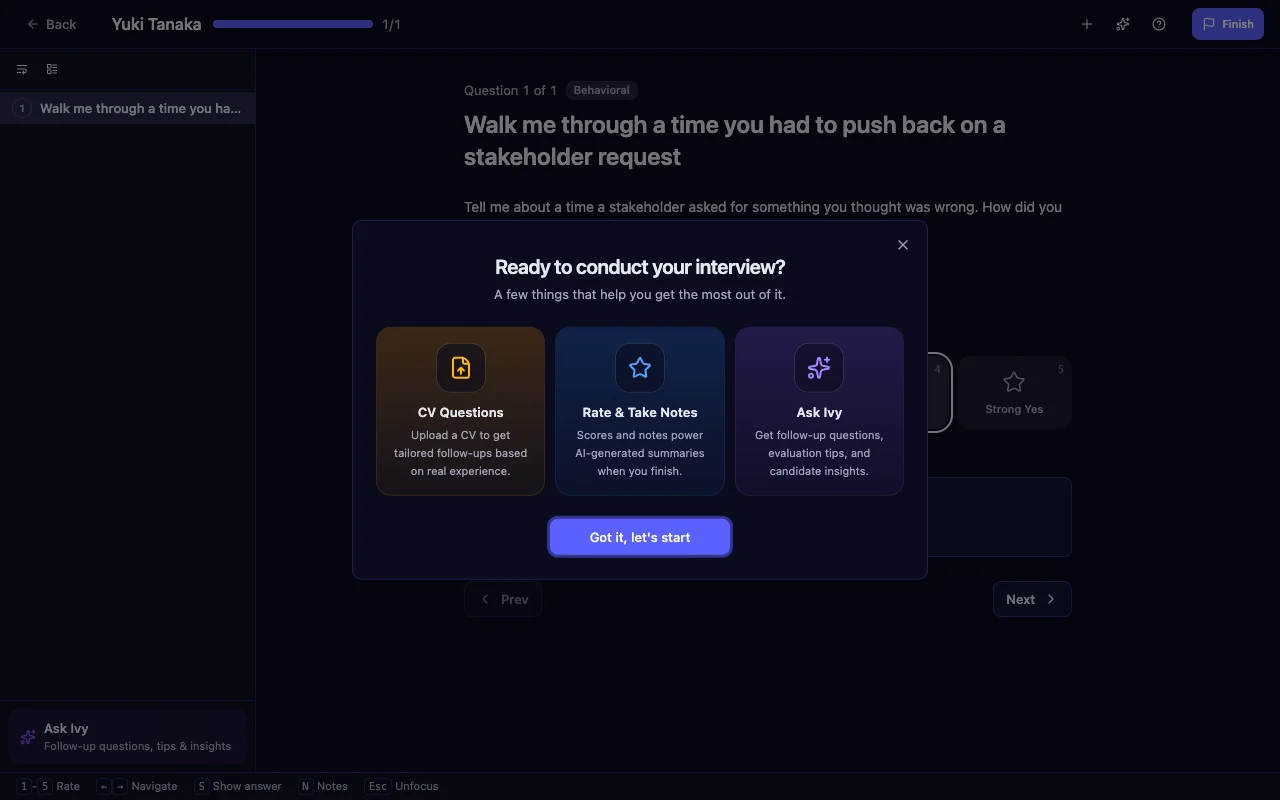
Every question in an Intervy interview gets a 1-5 rating plus a free-text comment:
- Strong No (1) — fundamentally wrong answer or can't engage with the question
- No (2) — partial understanding with significant gaps (names MEDDICC but can't apply it)
- Maybe (3) — factually correct but surface-level, no specific deal or example
- Yes (4) — solid answer with a concrete deal, trade-offs, and reasoning
- Strong Yes (5) — exceptional depth — connects discovery to forecast to negotiation unprompted
Building Templates by Role
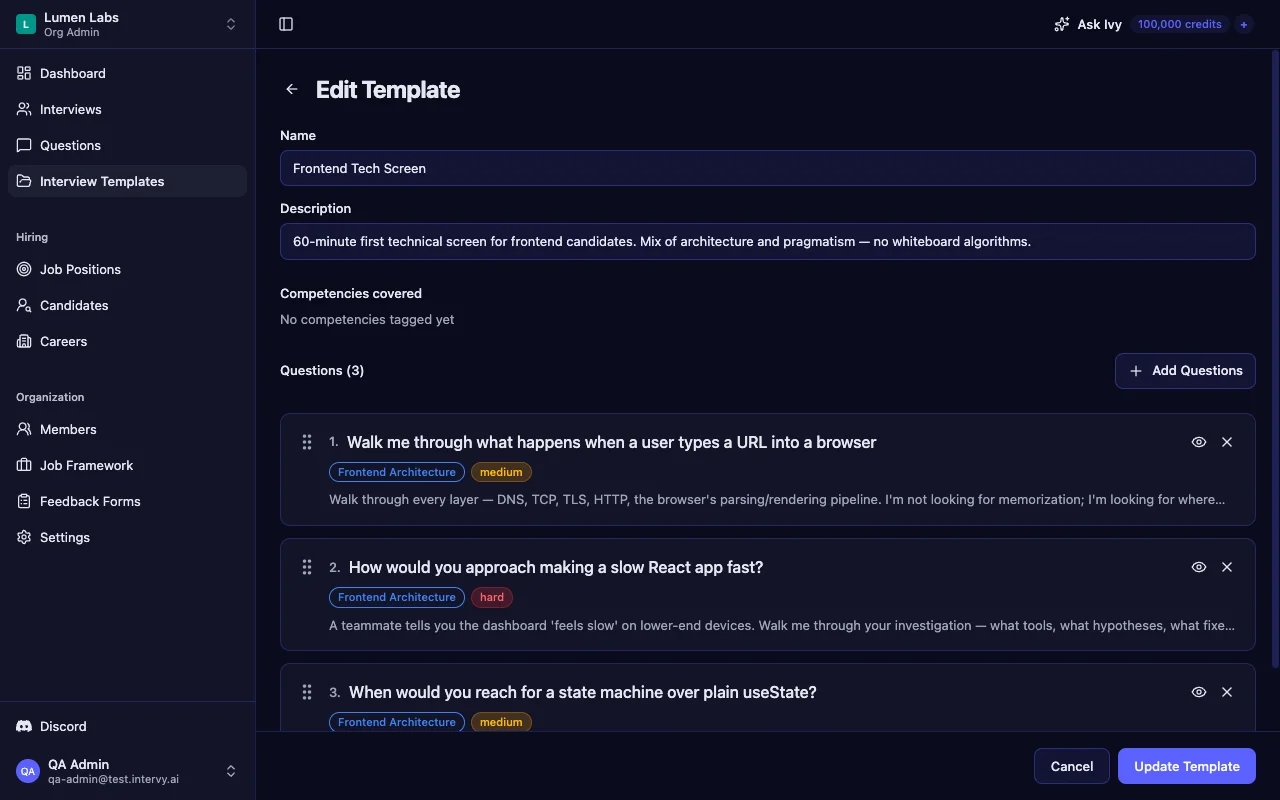
In the template editor, select questions from your bank and reorder them with drag-and-drop. Build a BDR phone screen (eight questions, easy-to-medium, weighted to Outbound and Behavioral) and a senior AE panel (twelve questions, medium-to-hard). Each template can be locked to a phase in your hiring pipeline — recruiter screen, hiring manager, panel, exec final.
Extending the Bank with AI
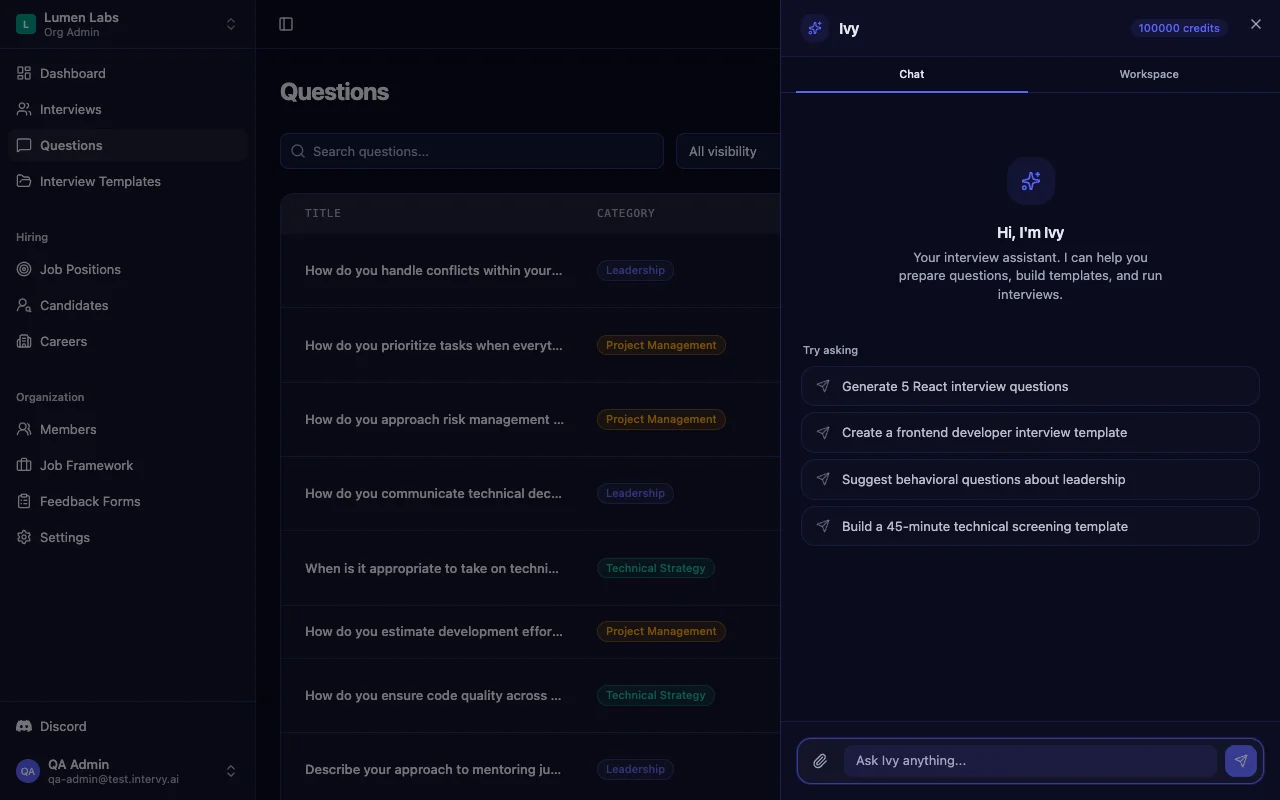
When you need a question that isn't in the seed — a mid-market AE versus an enterprise AE on a $500k ACP — Ivy, the built-in AI interview question generator, can draft role-specific questions on demand. Ask "give me five enterprise-AE MEDDICC questions focused on VP+ multi-threading" and Ivy returns drafts you save into your bank with one click — searching your existing library first so it doesn't duplicate what you already have.
Key takeaway: Repeatable beats clever. The same 12 questions and the same 5-point rubric across 30 candidates produces decisions you can defend. A loop where every interviewer asks their favorite questions produces vibes-based hires.
Start Running a Structured Sales Interview Loop
Structured sales interview questions produce structured sales hires. Organize by category and difficulty, put them into role-specific templates, and score every candidate on the same rubric.
The complete bank of 35 questions — with full reference answers, difficulty ratings, follow-up prompts, and category tags — is on our Sales Account Executive interview questions page. Browse every role on our interview questions index.
Want to use these in your next loop? Grab all 35 at once — head to our Import section, select the Sales Account Executive set, and load it into your Intervy workspace. Two templates ship with the import: an Account Executive panel and a BDR / SDR phone screen, both ready to drop into your hiring pipeline.