Technical Interview Questions: The Complete Guide for 2026
On this page
- Types of Technical Interview Questions
- Coding and Algorithm Questions
- System Design Questions
- Behavioral-Technical Questions
- Knowledge and Domain Questions
- How to Structure Technical Interview Questions by Difficulty
- Junior-Level Questions
- Mid-Level Questions
- Senior-Level Questions
- Role-Specific Technical Interview Question Categories
- Frontend Developer Questions
- Backend Developer Questions
- Full-Stack and DevOps Questions
- Common Mistakes with Technical Interview Questions
- Building a Technical Interview Question Bank That Scales
- Using an AI Interview Question Generator to Build Your Bank
- From Questions to a Structured Interview Tool
- Build Reusable Templates
- Score with a Consistent Rating Scale
- Review with Data, Not Opinions
- Start Building Your Question Bank
Hiring great engineers starts with asking the right technical interview questions. But most teams struggle with the same problems: interviewers ask wildly different questions, difficulty levels are inconsistent, and there's no shared system for comparing candidates. This guide covers every type of technical interview question, how to structure them by role and difficulty, and how to build a question bank that actually scales with your team.
TL;DR: Structure your technical interview questions by type (coding, system design, behavioral, domain), difficulty (junior/mid/senior), and role. Back every question with a reference answer. Put them into repeatable templates with consistent scoring.
Types of Technical Interview Questions
Not all technical questions serve the same purpose. Understanding the different types helps you build interviews that assess candidates holistically rather than testing a single narrow skill.
Coding and Algorithm Questions
The classic whiteboard-style problems — implement a function, optimize an algorithm, or debug a piece of code. They test a candidate's ability to write working code under pressure and reason about time and space complexity.
Good coding questions have a clear problem statement, an expected input/output format, and multiple valid approaches. Avoid trick questions that rely on obscure language features. Pick problems where the candidate's thought process matters more than getting the "right" answer.
System Design Questions
System design questions ask candidates to architect a solution at scale — "Design a URL shortener," "How would you build a real-time notification system?" These are essential for mid-level and senior roles where engineers need to think about trade-offs, scalability, and failure modes.
Tip: Set clear constraints (expected traffic, latency requirements, data volume) so the candidate has something concrete to work with. Open-ended questions without constraints lead to unfocused conversations.
Behavioral-Technical Questions
These sit at the intersection of soft skills and technical depth. "Tell me about a time you had to debug a production outage" or "How do you approach code reviews?" They reveal how a candidate operates in a real team environment — communication, prioritization, and technical judgment.
Behavioral-technical questions are often underused. They're particularly valuable because they're hard to rehearse with generic answers. A candidate's real experience shows through in the details.
Knowledge and Domain Questions
Domain questions test specific expertise — "Explain the event loop in JavaScript," "What's the difference between TCP and UDP?" They're useful for verifying that a candidate has hands-on experience with the technologies your team uses.
Use these sparingly. A few targeted knowledge questions confirm familiarity; too many turn the interview into a trivia contest.
How to Structure Technical Interview Questions by Difficulty
One of the most common mistakes is throwing senior-level questions at junior candidates (or vice versa). Structure your questions into clear difficulty tiers so your interviews match the role.
Junior-Level Questions
Focus on fundamentals: basic data structures, simple algorithms, core language features, and standard library usage. Junior candidates should demonstrate that they can write clean, working code and understand foundational concepts.
Mid-Level Questions
Add complexity: multi-step problems, basic system design, performance considerations, and debugging scenarios. Mid-level candidates should show that they can break down larger problems, consider edge cases, and make trade-off decisions.
Senior-Level Questions
Shift toward architecture, leadership, and depth: large-scale system design, cross-team coordination, mentoring approaches, and deep expertise in specific domains. Senior candidates should drive the conversation, ask the right questions before diving in, and articulate trade-offs clearly.
Key takeaway: Difficulty tiers aren't just about harder problems. Junior questions test "can you do it?" Mid questions test "can you do it well?" Senior questions test "can you decide what to do?"
Role-Specific Technical Interview Question Categories
Generic interview questions waste everyone's time. Tailor your questions to the specific role you're hiring for.
Frontend Developer Questions
Cover DOM manipulation, CSS layout systems, accessibility, state management, component architecture, and browser performance. For React roles, ask about hooks, rendering behavior, and component composition. For general frontend, focus on vanilla JavaScript, event handling, and responsive design.
Backend Developer Questions
Focus on API design, database modeling, authentication patterns, concurrency, error handling, and deployment pipelines. Language-specific questions (Go concurrency, Python async, Java memory model) are appropriate when the role requires deep expertise in a particular stack.
Full-Stack and DevOps Questions
These roles need breadth. Cover the full request lifecycle — from browser to server to database and back. For DevOps-leaning roles, add questions about CI/CD pipelines, container orchestration, monitoring, and incident response.
Common Mistakes with Technical Interview Questions
Even experienced interviewers fall into traps that make their questions less effective.
Asking trivia instead of problems. "What does the volatile keyword do?" tests memory, not engineering ability. Prefer questions where candidates demonstrate reasoning.
No reference answers. If interviewers don't agree on what a good answer looks like, scoring becomes subjective. Write reference answers for every question so all interviewers calibrate to the same standard.
Inconsistent difficulty. One interviewer asks easy warmups while another jumps straight to distributed systems. Without explicit difficulty labels, candidates get wildly different experiences.
No structure. Ad-hoc interviews where each interviewer picks random questions lead to gaps in coverage and duplicate assessments. Use templates to ensure consistent coverage across candidates.
Tip: The fix for all four mistakes is the same: a shared question bank with reference answers, difficulty labels, and reusable templates.
Building a Technical Interview Question Bank That Scales
A question bank is only useful if it's organized, searchable, and maintained. Scattered Google Docs and Notion pages break down as your team grows.
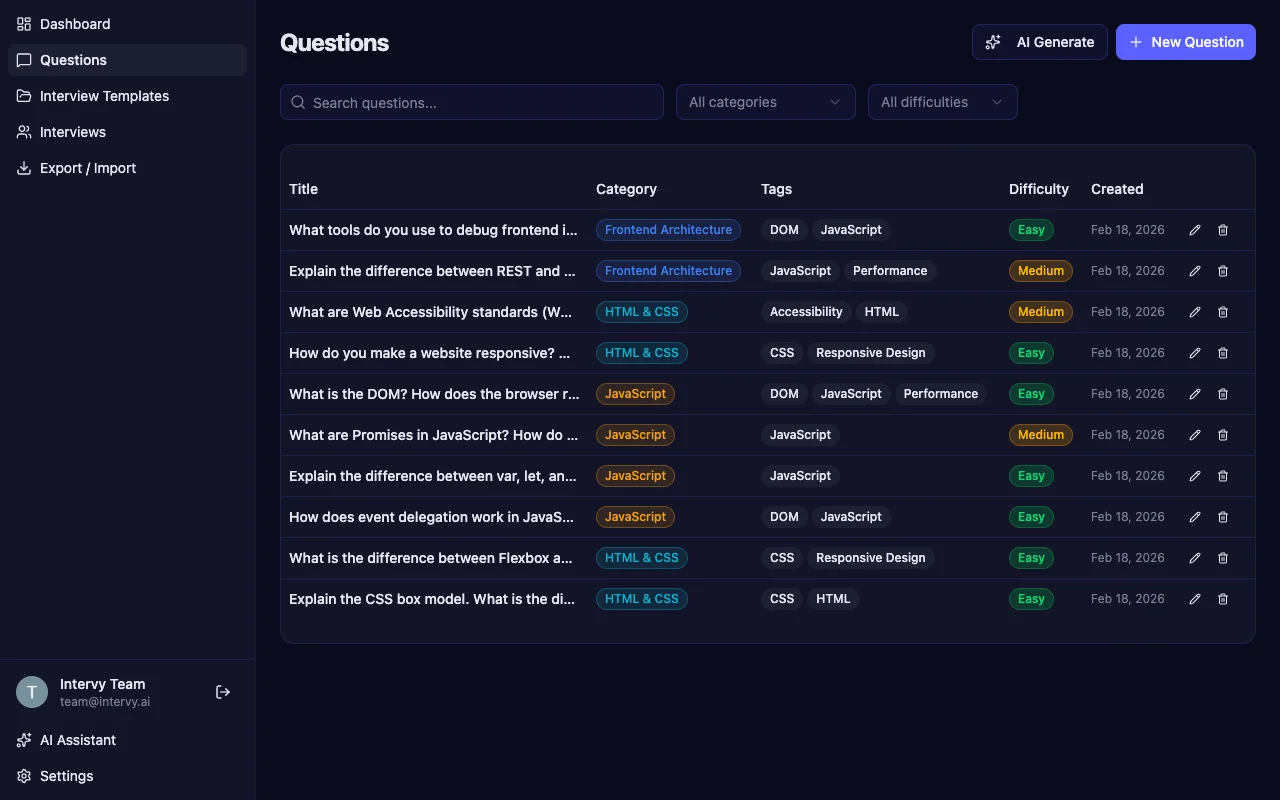
Intervy gives you a centralized question bank where every question supports Markdown formatting with syntax-highlighted code blocks. Each question gets structured metadata: a color-coded category, tags for cross-cutting concerns, and a difficulty level (easy, medium, or hard). This metadata powers filtering so you can quickly find the right questions when building interview templates.
You don't need to start from zero either. Intervy ships with pre-built seed data sets — frontend developer, backend developer, project lead, and scrum master — each with 10 categorized, tagged, and difficulty-rated questions ready to load with one click.
Using an AI Interview Question Generator to Build Your Bank
Writing high-quality technical interview questions is time-consuming. An AI interview question generator can speed up the process without sacrificing quality.
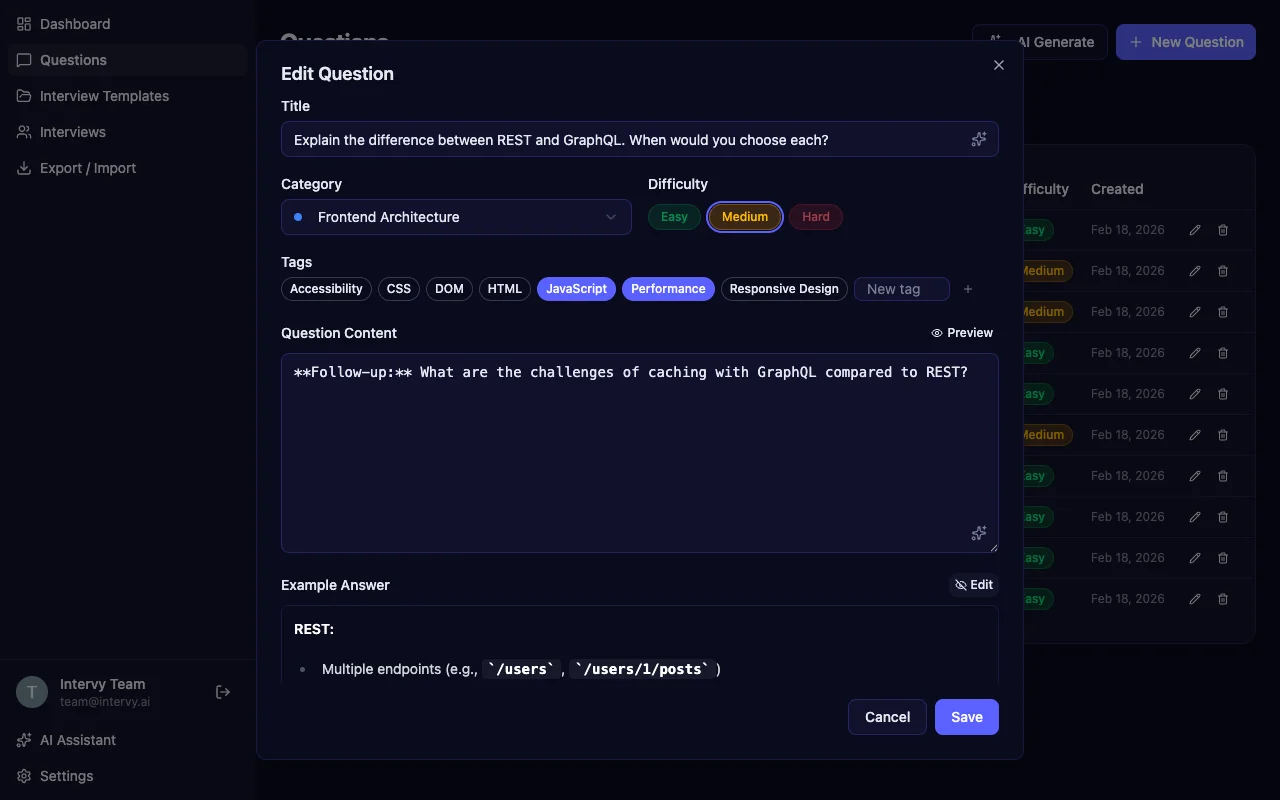
In Intervy, open the Ivy panel and describe what you need in natural language — "Generate React interview questions for a senior candidate" or "Create system design questions about distributed caching." The AI generates complete questions with titles, Markdown content, reference answers, category assignments, and difficulty levels.
Beyond full question generation, each field in the question editor — title, content, and answer — has its own AI generate button. Already wrote the question but stuck on the reference answer? Click the sparkles button on the answer field and the AI fills it based on your question content.
Every account starts with 300 free AI credits to try question generation. Need more? Purchase credit packs or bring your own API key (BYOK) — connect your Anthropic or OpenAI key and requests go directly to your provider.
From Questions to a Structured Interview Tool
Great questions are only half the equation. The other half is how you use them in actual interviews.
Build Reusable Templates
Organize your questions into interview templates — a "Frontend Developer Screen" or a "System Design Deep Dive." Intervy's template builder uses a split-panel layout: browse your question bank on one side, build your template on the other, and reorder questions with drag-and-drop.
Score with a Consistent Rating Scale
During a live interview, rate each answer from 1 to 5: Strong No, No, Maybe, Yes, or Strong Yes. Add comments that auto-save as you type. This gives every interviewer the same evaluation framework.
Review with Data, Not Opinions
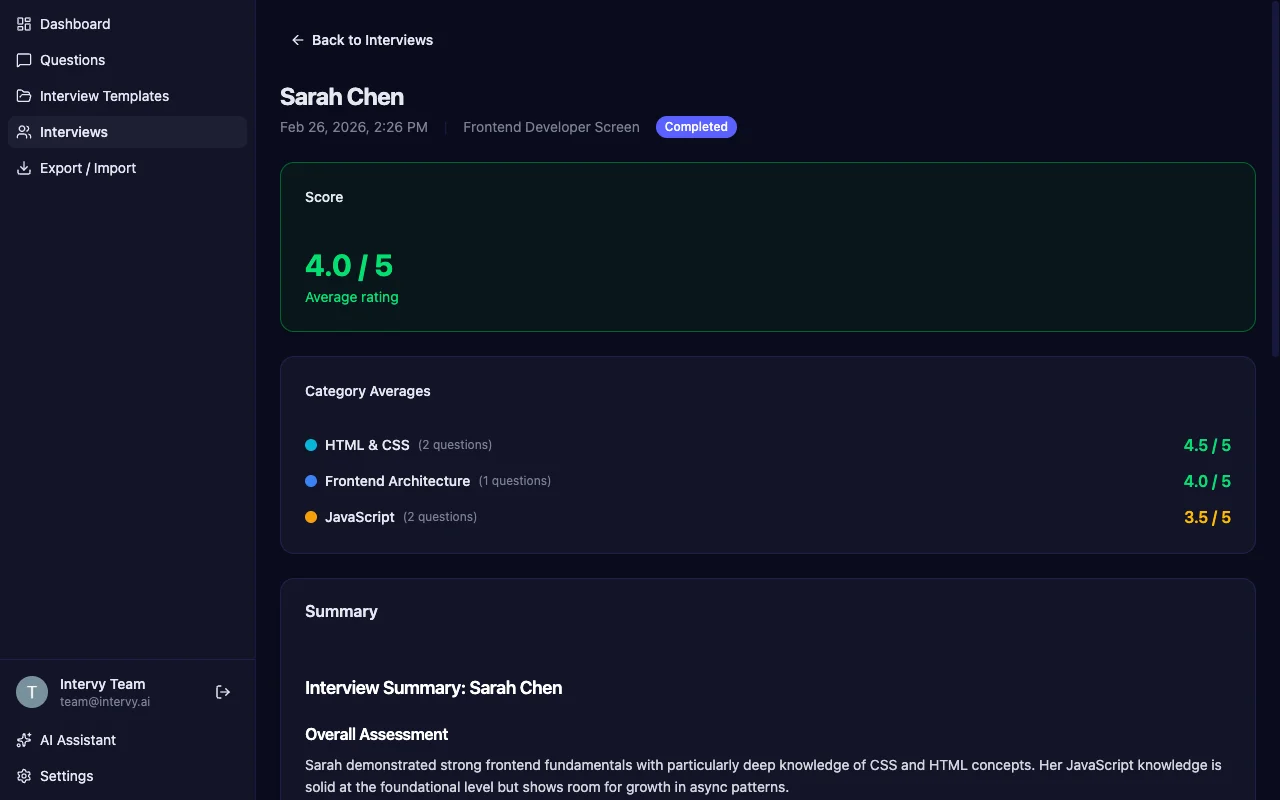
After the interview, Intervy's review page shows color-coded score cards, per-category averages, and an AI-generated summary. Green for strong performers, amber for borderline, red for weak signals.
Start Building Your Question Bank
Technical interview questions deserve the same rigor as the code your team writes. Structure them by type and difficulty. Organize them by role. Back every question with a reference answer. Then put them into repeatable templates with consistent scoring.
Head to Intervy — a technical interview platform for hiring managers — to start building your question bank, or read our AI interview preparation guide for a deeper look at generating questions and templates with AI.